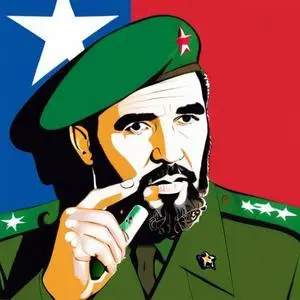
Fidel Castro: The Revolutionary Architect of Modern Cuba
The Face of the Cuban Revolution
Fidel Castro is synonymous with the Cuban Revolution, a charismatic leader who transformed the island nation into a socialist state and defied the United States' dominance in the region. For nearly five decades, Castro was the prime minister and president of Cuba, governing with an iron fist and an unwavering commitment to his Marxist-Leninist ideology.
A Humble Beginning
Born on August 13, 1926, in Birán, Oriente Province, Cuba, Fidel Castro Ruz was the son of Ángel Castro y Argiz, a wealthy Spanish farmer. Castro's early life was marked by a strong sense of social justice, which was further solidified during his university days at the University of Havana, where he studied law and became increasingly involved in leftist politics.
The Road to Revolution
Castro's revolutionary journey began in the early 1950s, when he participated in rebellions against right-wing governments in the Dominican Republic and Colombia. In 1953, he launched a failed attack on the Moncada Barracks, an act that would eventually lead to his imprisonment for a year. Upon his release, Castro traveled to Mexico, where he formed the 26th of July Movement with his brother
Raúl Castro and Argentine revolutionary
Ernesto "Che" Guevara.
The Triumph of the Cuban Revolution
In 1956, Castro returned to Cuba and led the 26th of July Movement in a guerrilla war against the authoritarian government of
Fulgencio Batista. The revolutionaries, based in the Sierra Maestra mountains, waged a successful campaign against the Batista regime, ultimately leading to its collapse in 1959. On February 16, 1959, Castro assumed military and political power as Cuba's prime minister, marking the beginning of a new era in Cuban history.
The Cold War and the Soviet Alliance
The United States, wary of Castro's socialist leanings, responded to the revolution with hostility, attempting to remove him through various means, including assassination plots, economic embargoes, and counter-revolutionary efforts, such as the Bay of Pigs Invasion in 1961. Castro countered these threats by aligning with the Soviet Union, allowing the placement of nuclear-armed ballistic missiles in Cuba, which led to the Cuban Missile Crisis in 1962. This event brought the world to the brink of nuclear war and cemented Castro's reputation as a shrewd and defiant leader.
A Marxist-Leninist State
Under Castro's leadership, Cuba underwent a radical transformation, adopting a Marxist-Leninist model of development. The Communist Party of Cuba, with Castro as its first secretary, became the sole governing party, and the country embarked on a path of rapid industrialization and socialization. Nationalization of industries, redistribution of land, and the implementation of socialist reforms became hallmarks of Castro's administration.
Personal Milestones and Key Life Events
- 1959: Becomes prime minister of Cuba
- 1965: Becomes first secretary of the Communist Party of Cuba
- 1976: Becomes president of Cuba
- 2008: Steps down as president due to health reasons
- 2011: Steps down as first secretary of the Communist Party of Cuba
- 2016: Passes away on November 25, at the age of 90
Influence on Modern Society
Fidel Castro's impact on modern society is multifaceted. His revolution inspired left-wing movements across the globe, and his defiance of the United States solidified Cuba's independence. Castro's commitment to social welfare and education resulted in significant improvements in healthcare, literacy, and living standards for the Cuban people.
Controversies and Public Perception
Castro's authoritarian leadership style, human rights abuses, and restrictions on political freedom have been the subject of intense criticism. His regime was often accused of suppressing dissent, and his treatment of political opponents, intellectuals, and the LGBTQ+ community was widely condemned.
Quotes and Memorable Sayings
- "A revolution is not a bed of roses. A revolution is a struggle to the death between the future and the past."
- "Men do not shape destiny, Destiny produces the man for the hour."
- "I am not a utensil of the Soviet Union. I am a revolutionist, a Cuban, and a communist."
Legacy
Fidel Castro's legacy is a complex and contested terrain. While critics view him as a ruthless dictator, many Cubans and international supporters see him as a champion of socialism, independence, and anti-imperialism. As a historical figure, Castro's significance extends beyond the bounds of Cuba, representing a defiant challenge to the dominant world order and a symbol of revolutionary fervor.
FAQ
What was Fidel Castros role in the Cuban Revolution?
Fidel Castro was the leader of the Cuban Revolution, overthrowing the authoritarian government of Fulgencio Batista in 1959. He played a crucial role in establishing a socialist government in Cuba.
What were Fidel Castros policies as President of Cuba?
As President of Cuba, Fidel Castro implemented a series of socialist policies, including nationalizing industries, redistributing land, and providing free education and healthcare to all citizens.
How did Fidel Castros government interact with the United States?
Fidel Castros government had a tense relationship with the United States, which imposed a trade embargo on Cuba in 1960. Castros government aligned itself with the Soviet Union, leading to the Cuban Missile Crisis in 1962.
What was Fidel Castros personal life like?
Fidel Castro had a complex personal life, with multiple marriages and children. He was known for his simplicity and frugality, despite being the leader of Cuba.
What is Fidel Castros legacy in modern Cuba?
Fidel Castros legacy in modern Cuba is complicated, with some viewing him as a revolutionary hero and others criticizing his authoritarian rule. His brother, Raúl Castro, succeeded him as President of Cuba in 2008.