


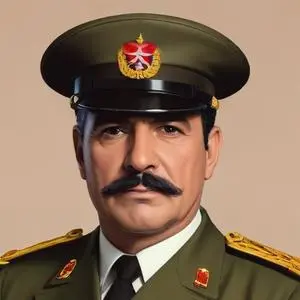
The authoritarian leader who ruled Cuba from 1933 to 1944 and again from 1952 to 1959, known for his corrupt and oppressive regime, which sparked the Cuban Revolution.
Fulgencio Batista, a name synonymous with Cuban politics and authoritarian rule, was a dominant figure in Cuban history, serving as both an elected president and a military dictator. He is known for his iron-fisted rule, corrupt government, and close ties with the United States, which ultimately led to his downfall in the Cuban Revolution.
Fulgencio Batista y Zaldívar, born Rubén Zaldívar on January 16, 1901, was a Cuban military officer and politician. He rose to power as part of the 1933 Revolt of the Sergeants, which overthrew the provisional government of Carlos Manuel de Céspedes y Quesada. Batista then appointed himself chief of the armed forces, with the rank of colonel, and effectively controlled the five-member pentarchy that functioned as the collective head of state.
Batista's first term as president was marked by a populist platform, and he was elected in 1940. During this period, he instated the 1940 Constitution of Cuba and served until 1944. His presidency was characterized by a series of liberal reforms, including the establishment of a minimum wage, an eight-hour workday, and the creation of a social security system.
After finishing his term, Batista moved to Florida, returning to Cuba to run for president in 1952. However, facing certain electoral defeat, he led a military coup against President Carlos Prío Socarrás, preempting the election. Back in power, Batista suspended the 1940 Constitution and revoked most political liberties, including the right to strike.
Batista's regime was marked by a stagnating economy that widened the gap between rich and poor Cubans. He aligned with the wealthiest landowners, who owned the largest sugar plantations, and presided over a regime that systematically profited from the exploitation of Cuba's commercial interests. He negotiated lucrative relationships with the American Mafia, who controlled the drug, gambling, and prostitution businesses in Havana, and with large U.S.-based multinational companies who were awarded lucrative contracts.
The growing discontent amongst the populace, fueled by Batista's repressive regime, eventually led to his downfall. The Cuban Revolution, led by Fidel Castro, Che Guevara, and the 26th of July Movement, overthrew Batista's government on January 1, 1959. Batista fled to Spain, where he died on August 6, 1973.
Batista was known for his charismatic personality and his ability to manipulate the media. One of his famous quotes is: "I'm not a dictator. It's just that I have a firm hand."
Batista's regime was a stark contrast to the democratic ideals of the Cuban Revolution. His authoritarian rule and corrupt government paved the way for the revolution, which brought about significant social and economic changes in Cuba. In comparison to his contemporaries, Batista's regime was marked by its brutal suppression of dissent and its close ties with the United States.
Batista's regime and the Cuban Revolution have been the subject of numerous films, books, and songs. The Godfather II, a classic film by Francis Ford Coppola, features a fictionalized account of the Cuban Revolution and Batista's regime.
Fulgencio Batista's legacy is a complex one, marked by both liberal reforms and authoritarian rule. His regime's corruption and suppression of dissent paved the way for the Cuban Revolution, which brought about significant changes in Cuba. Today, Batista remains a controversial figure, remembered for his iron-fisted rule and his impact on Cuban history.
Born in 1882
A Cuban physician and politician who served as the 6th President of Cuba, known for his efforts to reform the country's healthcare system and establish a more democratic government. He played a significant role in shaping Cuba's modern history.
Born in 1891
A ruthless dictator who ruled the Dominican Republic with an iron fist, known for his brutal suppression of opposition and human rights abuses.
Born in 1926
The Cuban revolutionary who led the country from 1959 to 2008, implementing socialist policies and defying US opposition, becoming an iconic figure in modern history.
95 Years Old
The Cuban revolutionary leader who served as President of Cuba from 2008 to 2018, known for implementing economic reforms and improving relations with the US. He played a key role in shaping Cuba's socialist government and economy.
