


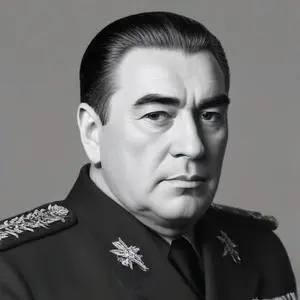
A Soviet leader who ruled with an iron fist, implementing policies that stagnated the economy and suppressed dissent, while also being a key figure in the Cold War. He's infamous for his authoritarian regime and bureaucratic inefficiency.
Leonid Brezhnev, the stalwart leader of the Soviet Union, is remembered for his 18-year tenure as General Secretary of the Communist Party, a reign that saw the Soviet Union's international standing improve significantly and its ruling party stabilize its position at home. As the second-longest-serving General Secretary in Soviet history, Brezhnev left an indelible mark on the country's politics, economy, and society.
Born on December 19, 1906, in Kamenskoye, Ukraine, Brezhnev grew up in a working-class family within the Russian Empire. After joining the Communist Party's youth league in 1923, he became an official party member in 1929. During World War II, he served as a commissar in the Red Army, rising rapidly through the ranks to become a major general.
In 1952, Brezhnev was promoted to the party's Central Committee and became a full member of the Politburo by 1957. He consolidated his power by building alliances and maneuvering through the party's inner circles. In 1964, he replaced Nikita Khrushchev as First Secretary of the CPSU, solidifying his position as the most powerful person in the Soviet Union.
Brezhnev's leadership style was marked by his emphasis on consensus-building among the party elite. He fostered a sense of collective leadership, ensuring that decisions were made through collaboration and compromise. This approach helped to minimize dissent and stabilize the party's position at home.
During his tenure, Brezhnev achieved several significant milestones, including:
Brezhnev's personal life was marked by several significant events, including:
Brezhnev's legacy is complex and multifaceted. While he stabilized the Soviet Union's political landscape and improved its international standing, he also oversaw a period of stagnation and corruption. His emphasis on collective leadership and consensus-building helped to maintain party unity, but it also hindered innovation and reform.
Despite these contradictions, Brezhnev's impact on modern society is undeniable. He played a crucial role in shaping the Cold War-era political landscape and left a lasting legacy in Soviet politics, economy, and culture.
Brezhnev was known for his pragmatism and dry wit. Some of his most memorable quotes include:
Brezhnev's leadership style and accomplishments can be compared to those of his contemporaries, such as Soviet leaders Joseph Stalin and Nikita Khrushchev, as well as international leaders like US President Richard Nixon. While each of these leaders had their own unique strengths and weaknesses, Brezhnev's ability to balance consensus-building with pragmatic decision-making sets him apart.
In conclusion, Leonid Brezhnev's life and legacy serve as a testament to the complexities of Soviet politics and the enduring impact of his leadership on modern society.
Born in 1894
The Soviet leader who initiated reforms and denounced Stalin's regime, known for his bold policies and iconic shoe-banging incident at the UN.
Born in 1878
The Soviet Union's ruthless leader who ruled with an iron fist, implementing policies that led to widespread famine and purges, while also playing a crucial role in defeating Nazi Germany in World War II.
95 Years Old
The last leader of the Soviet Union, who introduced reforms that led to the end of the Cold War and the collapse of communism, earning a Nobel Peace Prize. He's known for his policies of glasnost and perestroika, which transformed the Soviet Union and the world.
Born in 1870
Founder of the world's first socialist state, leading the Bolshevik Revolution and establishing the Soviet Union, known for his radical Marxist ideology and authoritarian rule.
Born in 1909
Soviet Minister of Foreign Affairs who played a crucial role in shaping the country's foreign policy during the Cold War, known for his diplomatic skills and ability to navigate complex international relations.
Born in 1914
Leader of the Soviet Union from 1982 to 1984, known for attempting to reform the stagnant Soviet economy and crack down on corruption. Implemented policies to increase discipline and productivity.
Born in 1911
The last Soviet leader before Mikhail Gorbachev, he briefly ruled the USSR from 1984 to 1985, maintaining a hardline communist stance and resisting reform.
