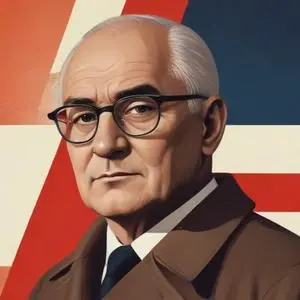
Yuri Andropov: The Enigmatic Soviet Leader
A Legacy of Reform and Controversy
Yuri Andropov, the sixth leader of the Soviet Union, is known for his brief but tumultuous tenure as General Secretary of the Communist Party of the Soviet Union from 1982 until his death in 1984. Andropov's leadership was marked by an unprecedented wave of reforms aimed at curtailing corruption and inefficiency, which ultimately paved the way for the rise of
Mikhail Gorbachev and the eventual dissolution of the Soviet Union.
Early Life and Career
Born on June 15, 1914, in Stanitsa Nagutskaya, Russia (now Stavropol Krai), Andropov's family background has been shrouded in controversy. His father, Vladimir Konstantinovich Andropov, a railway worker of Don Cossack descent, died of typhus in 1919. Andropov's mother, Yevgenia Karlovna Fleckenstein, raised him in modest circumstances.
Andropov's career in the Soviet apparatus began in 1939, when he joined the Communist Party. He quickly rose through the ranks, serving as the Soviet ambassador to Hungary from 1954 to 1957, during which time he played a key role in suppressing the 1956 Hungarian Uprising. In 1967, Andropov was appointed chairman of the KGB, a position he held until 1982.
Rise to Power and Reforms
Following
Leonid Brezhnev's death in 1982, Andropov succeeded him as General Secretary of the Communist Party of the Soviet Union. During his short tenure, Andropov sought to eliminate corruption and inefficiency in the country by criminalizing truancy in the workplace and investigating longtime officials for violations of party discipline. He also brought to the fore a new generation of young reformers, including
Yegor Ligachyov, Nikolai Ryzhkov, and Mikhail Gorbachev.
Foreign Policy and the Cold War
Andropov's leadership coincided with a period of heightened tension in the Cold War. Despite his tough stance on dissent and reform, Andropov was at a loss for how to handle the growing crisis in the Soviet economy. His tenure saw a significant escalation of the Cold War, with the Soviet Union increasingly isolated on the international stage.
Personal Life and Health Issues
Andropov suffered from poor health throughout his life, particularly in his later years. In February 1983, he suffered kidney failure, which led to a rapid deterioration of his health. He died on February 9, 1984, at the age of 69, after leading the country for approximately 15 months.
Legacy and Impact
Andropov's legacy is complex and multifaceted. While his reforms paved the way for the eventual dissolution of the Soviet Union, they also marked a significant shift towards greater accountability and transparency in the Soviet government. His promotion of young reformers, including Mikhail Gorbachev, had a lasting impact on Soviet politics and ultimately contributed to the downfall of communism.
Quotes and Memorable Sayings
"The task of the communist party is to lead the toilers of all nations to the bright future of communism."
"We must promote the development of the creative faculties of every individual, and create an atmosphere in which people can develop freely."
Trivia and Fun Facts
- Andropov was known for his love of jazz music and was a self-taught saxophonist.
- He was the first Soviet leader to be born after the Russian Revolution of 1917.
- Andropov's health issues prevented him from appearing in public for the last six months of his life.
Historical Context and Legacy
Andropov's leadership marked a turning point in Soviet history, as the country began to grapple with the consequences of decades of communist rule. His reforms and promotion of young reformers paved the way for the eventual dissolution of the Soviet Union and the rise of a new generation of leaders, including Mikhail Gorbachev. Today, Andropov is remembered as a complex and enigmatic figure, whose legacy continues to shape our understanding of the Soviet Union and its eventual demise.
FAQ
What was Yuri Andropovs role in the Soviet Union?
Yuri Andropov was a Soviet politician who served as the General Secretary of the Communist Party of the Soviet Union from 1982 until his death in 1984.
How did Yuri Andropovs KGB background influence his political career?
Yuri Andropovs experience as the head of the KGB (Committee for State Security) from 1967 to 1982 shaped his political career and informed his policies as General Secretary.
What reforms did Yuri Andropov attempt to implement in the Soviet Union?
Yuri Andropov attempted to implement reforms aimed at reviving the Soviet economy and improving living standards. He introduced anti-corruption measures and promoted younger, more dynamic leaders.
How did Yuri Andropovs leadership style differ from his predecessors?
Yuri Andropovs leadership style was marked by a more pragmatic and reform-oriented approach, which distinguished him from his predecessors, such as Leonid Brezhnev.
What was Yuri Andropovs stance on international relations?
Yuri Andropov adopted a cautious approach to international relations, seeking to reduce tensions with the West while maintaining the Soviet Unions influence and credibility.