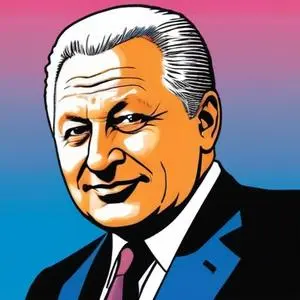
Boris Yeltsin: The Architect of Modern Russia
The Rise of a Reformer
Boris Yeltsin is renowned for being the first President of Russia, serving from 1991 to 1999, and playing a pivotal role in the country's transition from a communist command economy to a capitalist market economy. He is also credited with dismantling the Soviet Union, ultimately leading to its dissolution in December 1991.
Early Life and Career
Born on February 1, 1931, in Butka, Ural Oblast, Yeltsin grew up in Kazan and Berezniki. He studied at the Ural State Technical University and later worked in construction before joining the Communist Party of the Soviet Union in 1961. Yeltsin's political career began to take shape when he became the First Secretary of the party's Sverdlovsk Oblast committee in 1976.
Perestroika and the Road to Power
Initially a supporter of
Mikhail Gorbachev's perestroika reforms, Yeltsin soon became disillusioned with the pace of change and began advocating for more radical transformations. This stance earned him popularity as an anti-establishment figure, particularly after his resignation from the Politburo in 1987. In 1990, he was elected chair of the Russian Supreme Soviet, and in 1991, he became the first popularly elected head of state in Russian history as the President of the Russian Soviet Federative Socialist Republic (RSFSR).
Economic Reforms and Privatization
Yeltsin's presidency was marked by a series of economic reforms, including the implementation of shock therapy, market exchange rate of the ruble, and nationwide privatization. These measures aimed to transform Russia's command economy into a market-based economy, although they were marred by controversy and corruption allegations.
Controversies and Public Perception
Yeltsin's leadership style was often criticized for being authoritarian, and his re-election in 1996 was tainted by claims of electoral fraud. His presidency was also marked by a series of high-profile controversies, including the 1993 constitutional crisis, which saw him clash with the Russian parliament.
Personal Milestones and Key Life Events
- 1931: Born in Butka, Ural Oblast
- 1961: Joined the Communist Party of the Soviet Union
- 1976: Became First Secretary of the party's Sverdlovsk Oblast committee
- 1987: Resigned from the Politburo
- 1990: Elected chair of the Russian Supreme Soviet
- 1991: Elected President of the Russian Soviet Federative Socialist Republic
- 1996: Reelected as President of Russia
- 1999: Resigned as President of Russia
- 2007: Passed away on April 23rd
Legacy and Impact on Modern Russia
Yeltsin's presidency has had a lasting impact on modern Russia. His economic reforms, though controversial, paved the way for Russia's integration into the global economy. Additionally, his role in dismantling the Soviet Union and establishing Russia as an independent state has cemented his place in history as a key figure in the country's transformation.
Quotes and Memorable Sayings
- "We Don't Want a Revolution, We Want a Normal, Democratic State"
- "Russia Will Not Soon Become, If It Ever Becomes, a Second-Generation Capitalist Society"
Historical Context and Comparative Analysis
Yeltsin's presidency coincided with a period of significant global change, including the end of the Cold War and the rise of globalization. In comparison to his contemporaries, such as Mikhail Gorbachev, Yeltsin's leadership style was marked by a more radical approach to reform, which has been both praised and criticized by historians and political analysts.
FAQ
What were the key reforms of Boris Yeltsins presidency?
Boris Yeltsins presidency was marked by a series of radical reforms, including the privatization of state-owned enterprises, liberalization of prices, and democratization of the political system. He also introduced a new constitution and established the office of the president.
How did Boris Yeltsins presidency mark a turning point in Russian history?
Boris Yeltsins presidency marked a significant turning point in Russian history, as he oversaw the transition from a communist to a post-communist society. He played a crucial role in ending the Soviet Union and establishing Russia as an independent nation.
What was Boris Yeltsins relationship like with the Russian oligarchs?
Boris Yeltsins relationship with the Russian oligarchs was complex and controversial. While he relied on them for financial support and political backing, he also clashed with them over issues of power and influence, leading to a series of high-profile confrontations.
How did Boris Yeltsins health issues affect his presidency?
Boris Yeltsins health issues had a significant impact on his presidency, as he struggled with heart problems and other ailments throughout his term. His illness led to concerns about his ability to lead and sparked speculation about his successor.
What is Boris Yeltsins legacy in Russian politics?
Boris Yeltsins legacy in Russian politics is complex and contested. While he is credited with introducing democratic reforms and ending the Soviet Union, he is also criticized for his authoritarian tendencies and his role in consolidating power in the presidency.