


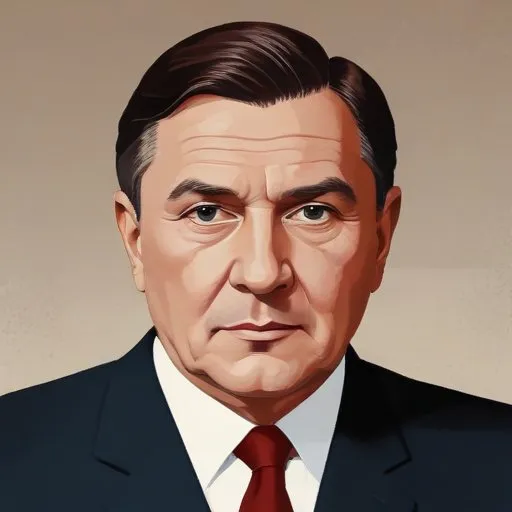
Soviet Minister of Foreign Affairs who played a crucial role in shaping the country's foreign policy during the Cold War, known for his diplomatic skills and ability to navigate complex international relations.
Andrei Gromyko, the Soviet politician and diplomat, is synonymous with the Cold War era. He is best known for his unwavering stance against Western powers, earning him the nickname "Mr. Nyet" or "Grim Grom," as well as his instrumental role in shaping Soviet foreign policy from the 1940s to the 1980s.
Born on July 18, 1909, in the village of Staryya Hramyki, Belarus, Gromyko joined the Communist Party in 1931. He quickly rose through the ranks, becoming the Soviet ambassador to the United States in 1943 and later, the Soviet Permanent Representative to the United Nations in New York.
In 1952, Gromyko became the Soviet ambassador to the United Kingdom, and it was during this period that he began to make a name for himself on the international stage. His diplomatic prowess and unyielding commitment to Soviet interests led to his appointment as the Minister of Foreign Affairs in 1957, a position he held for nearly three decades.
As Foreign Minister, Gromyko played a crucial role in negotiations with the United States during the Cuban Missile Crisis. His ability to find a solution to the crisis, which brought the world to the brink of nuclear war, earned him recognition as a skilled diplomat.
Under the leadership of Leonid Brezhnev, Gromyko was instrumental in establishing détente with the United States. He negotiated several landmark treaties, including the ABM Treaty, the Partial Nuclear Test Ban Treaty, and the SALT I and II agreements. These treaties marked a significant shift in Soviet foreign policy, as the country began to engage in diplomatic efforts to reduce tensions with the West.
During the 1970s and 1980s, Gromyko's conservative stance and distrust of the West continued to shape Soviet foreign policy. His influence extended beyond the realm of foreign policy, as he played a key role in dictating policymaking alongside other top officials.
Despite his rigid conservatism, Gromyko's legacy is marked by his ability to adapt to changing circumstances. He recognized the need for diplomatic engagement with the West, and his efforts paved the way for later reforms under Mikhail Gorbachev.
Andrei Gromyko's impact on Soviet foreign policy cannot be overstated. His unwavering commitment to Soviet interests and his ability to adapt to changing circumstances have left a lasting legacy. As one of the most influential diplomats of the Cold War era, Gromyko's name is synonymous with Soviet foreign policy, and his contributions continue to shape our understanding of international relations today.
Despite his passing on July 2, 1989, Gromyko's legacy lives on, serving as a testament to the power of diplomacy and the importance of understanding the complexities of international relations.
95 Years Old
The last leader of the Soviet Union, who introduced reforms that led to the end of the Cold War and the collapse of communism, earning a Nobel Peace Prize. He's known for his policies of glasnost and perestroika, which transformed the Soviet Union and the world.
Born in 1906
A Soviet leader who ruled with an iron fist, implementing policies that stagnated the economy and suppressed dissent, while also being a key figure in the Cold War. He's infamous for his authoritarian regime and bureaucratic inefficiency.
Born in 1894
The Soviet leader who initiated reforms and denounced Stalin's regime, known for his bold policies and iconic shoe-banging incident at the UN.
Born in 1878
The Soviet Union's ruthless leader who ruled with an iron fist, implementing policies that led to widespread famine and purges, while also playing a crucial role in defeating Nazi Germany in World War II.
Born in 1890
A Soviet Minister of Foreign Affairs who played a crucial role in shaping the country's foreign policy during World War II and the early Cold War era, known for his diplomatic skills and signature cocktails.
Born in 1914
Leader of the Soviet Union from 1982 to 1984, known for attempting to reform the stagnant Soviet economy and crack down on corruption. Implemented policies to increase discipline and productivity.
Born in 1911
The last Soviet leader before Mikhail Gorbachev, he briefly ruled the USSR from 1984 to 1985, maintaining a hardline communist stance and resisting reform.
Born in 1908
A Soviet military leader and politician who played a crucial role in the Soviet Union's defense industry and military strategy during World War II and the Cold War. He was a key figure in the development of the Soviet nuclear program and oversaw the production of military equipment and weapons.
