


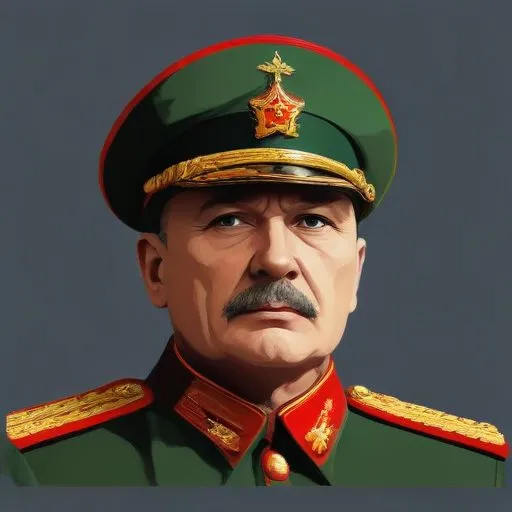
Soviet Minister of Defense from 1967 to 1976, overseeing the Soviet military during the Cold War and playing a key role in shaping the country's defense policies.
Andrei Antonovich Grechko was a Soviet military commander and Marshal of the Soviet Union, who served as the Soviet Minister of Defence from 1967 to 1976, playing a pivotal role in shaping the Cold War landscape. During his tenure, he oversaw the Warsaw Pact invasion of Czechoslovakia, violent border clashes with China, and was a strong advocate for the first strike nuclear strategy.
Grechko was born on October 17, 1903, in a small town near Rostov-on-Don, to a family of Ukrainian peasants. He joined the Red Army in 1919 and became part of the Budyonny Cavalry, fighting in the Russian Civil War. After graduating from the Frunze Military Academy, he took part in the Soviet invasion of Poland in 1939.
Grechko held a succession of cavalry and army commands during World War II, seeing action in the Caucasus, Ukraine, and Central Europe. After the war, he commanded the Kiev Military District and in 1953, he was appointed commander-in-chief of Soviet Forces in East Germany, where he led the suppression of the East German uprising. In 1955, he was named a Marshal of the Soviet Union.
Grechko was an ideological hardliner, who only reluctantly supported Leonid Brezhnev's détente with the United States and the Strategic Arms Limitation Talks (SALT). He was responsible for continuing the Soviet hegemony over Eastern Europe and played a crucial role in modernizing the Soviet Army. However, his hardline stance and advocacy for the first strike nuclear strategy have been widely criticized.
Grechko died on April 26, 1976, at the age of 72. Despite his controversial legacy, he remains an important figure in Soviet military history, whose decisions and actions had far-reaching consequences for the world.
Grechko's legacy continues to shape international relations and global politics. His advocacy for the first strike nuclear strategy and his role in the Cold War have had lasting impacts on the world's approach to nuclear disarmament and international relations.
Andrei Grechko was a complex figure, whose life and career were marked by significant achievements and controversies. As a key player in the Cold War, his decisions and actions continue to shape our world today, making him an important figure to study and understand.
Born in 1894
The Soviet leader who initiated reforms and denounced Stalin's regime, known for his bold policies and iconic shoe-banging incident at the UN.
Born in 1906
A Soviet leader who ruled with an iron fist, implementing policies that stagnated the economy and suppressed dissent, while also being a key figure in the Cold War. He's infamous for his authoritarian regime and bureaucratic inefficiency.
Born in 1911
The last Soviet leader before Mikhail Gorbachev, he briefly ruled the USSR from 1984 to 1985, maintaining a hardline communist stance and resisting reform.
Born in 1914
Leader of the Soviet Union from 1982 to 1984, known for attempting to reform the stagnant Soviet economy and crack down on corruption. Implemented policies to increase discipline and productivity.
Born in 1896
A Soviet military leader who played a crucial role in defeating Nazi Germany in World War II, and later became a key figure in Soviet politics.
