


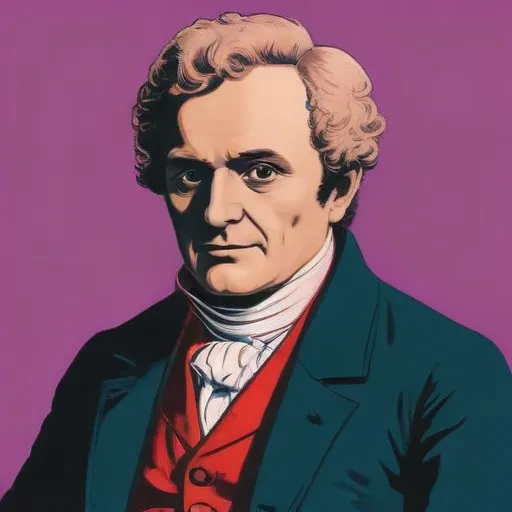
A utopian socialist who envisioned a society where people lived in harmony with their passions and the environment, and is known for his innovative ideas on social organization and urban planning.
Charles Fourier, a French philosopher and influential early socialist thinker, is best known for his radical ideas that have become mainstream in modern society. He is credited with coining the term "feminism" in 1837, and his social views and proposals inspired a whole movement of intentional communities.
Born on April 7, 1772, in Besançon, France, Fourier was the son of a small businessman. Despite his initial interest in architecture, he was unable to pursue a career in engineering due to his non-noble background. This setback, however, allowed him to focus on his true passion – helping humanity.
After his father's death in 1781, Fourier inherited a substantial amount of money, which enabled him to travel extensively throughout Europe. He worked as a traveling salesman and correspondence clerk in various cities, including Paris, Rouen, Lyon, Marseille, and Bordeaux, from 1791 to 1816.
Fourier's philosophical contributions were centered around the concept of utopian socialism. He believed in the creation of self-sufficient communities, where people could live and work together in harmony. He advocated for the equal distribution of wealth, the emancipation of women, and the abolition of poverty.
His most notable work, "The Social Destiny of Man," outlines his vision for a society in which people are free to develop their talents and pursue their passions. He also believed in the importance of education and advocated for the establishment of vocational schools and training programs.
Fourier's ideas have had a significant impact on modern society. His concept of feminism has become a cornerstone of modern feminist movement, and his advocacy for the equal distribution of wealth and the abolition of poverty has influenced socialist and communist movements around the world.
In the United States, his ideas inspired the creation of intentional communities, such as the community of Utopia, Ohio, La Reunion near present-day Dallas, Texas, and Brook Farm in West Roxbury, Massachusetts. In France, his influence can be seen in the Familistery of Guise.
"The extension of women's rights is the basic principle of all social progress."
Charles Fourier's legacy is that of a visionary thinker who dared to imagine a better world. His ideas, though radical in his lifetime, have become an integral part of modern society. He continues to inspire social reformers, feminists, and utopian thinkers around the world.
Few thinkers have had such a profound impact on modern society, and Fourier's influence will continue to be felt for generations to come.
Born in 1809
A 19th-century French economist and politician who advocated for anarchism, socialism, and mutualism, and is known for coining the phrase "Property is Theft."
Born in 1771
A pioneering figure in social reform, he advocated for better working conditions, education, and welfare for the working class, pioneering the concept of social responsibility in business.
Born in 1818
A 19th-century philosopher who developed the theory of communism, arguing that capitalism would eventually be replaced by a socialist society. He's known for his critique of capitalism and the concept of class struggle.
Born in 1820
A 19th-century philosopher and economist who co-authored "The Communist Manifesto" with Karl Marx, shaping modern socialist and communist thought. He also wrote extensively on economics, history, and politics.
Born in 1712
A pioneering thinker who shaped modern democracy and education with his ideas on social contracts, general will, and the importance of early childhood education. His writings influenced the French Revolution and modern political thought.
Born in 1694
A witty and insightful 18th-century writer and philosopher who used satire to critique societal norms and advocate for reason, tolerance, and human rights.
