


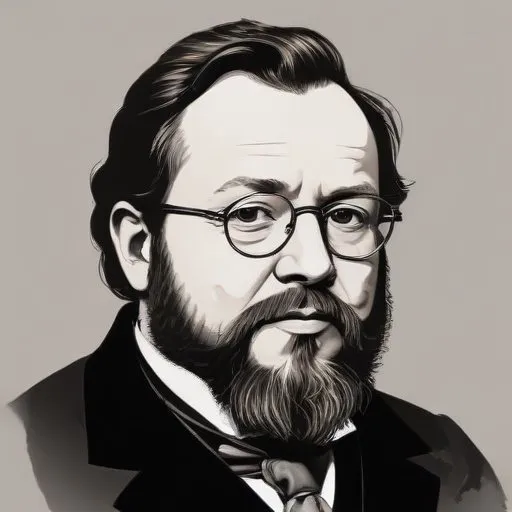
A 19th-century French economist and politician who advocated for anarchism, socialism, and mutualism, and is known for coining the phrase "Property is Theft."
French socialist, politician, philosopher, and economist Pierre-Joseph Proudhon is widely regarded as one of anarchism's most influential theorists and is often referred to as the "father of anarchism." He is best known for being the first person to declare himself an anarchist, using the term to describe his philosophy.
Born on January 15, 1809, in Besançon, France, Proudhon was a self-taught printer who learned Latin to better print books in the language. This skill would later serve him well in his publishing endeavors.
Proudhon's most famous assertion, "property is theft," was first introduced in his 1840 work, "What Is Property? Or, an Inquiry into the Principle of Right and Government." This concept challenged the traditional notion of property and sparked intense debate among philosophers and economists of the time.
As a mutualist philosopher, Proudhon believed in a synthesis of community and property, advocating for a decentralized, federalist system where individuals could own property and yet still contribute to the common good. His ideas have been interpreted as both individualist and social anarchism, making him a pivotal figure in the development of anarchist thought.
After the Revolution of 1848, Proudhon became a member of the French Parliament, where he referred to himself as a federalist. His influence extended beyond France, as his ideas inspired anarchist movements across Europe and the Americas.
Proudhon's correspondence with Karl Marx, another prominent socialist philosopher, had a significant impact on the development of both anarchism and Marxism. Although their friendship ultimately ended in a public feud, their intellectual exchange shaped the course of socialist thought.
Proudhon's ideas have had a lasting impact on anarchist thought and continue to influence contemporary debates on socialism, economics, and government. His critiques of private property and advocacy for decentralized systems have inspired generations of social reformers.
In the context of 19th-century European politics, Proudhon's ideas represented a radical challenge to the established order, paving the way for future anarchist and socialist movements.
Through his writings and activism, Pierre-Joseph Proudhon left an indelible mark on the development of anarchist thought, shaping the course of socialist philosophy and inspiring future generations of social reformers.
Born in 1818
A 19th-century philosopher who developed the theory of communism, arguing that capitalism would eventually be replaced by a socialist society. He's known for his critique of capitalism and the concept of class struggle.
Born in 1820
A 19th-century philosopher and economist who co-authored "The Communist Manifesto" with Karl Marx, shaping modern socialist and communist thought. He also wrote extensively on economics, history, and politics.
Born in 1814
A Russian philosopher and theorist who advocated for anarchism and the abolition of the state, and is known for his influence on the development of anarchist thought. His ideas emphasized individual freedom and the rejection of authority.
Born in 1772
A utopian socialist who envisioned a society where people lived in harmony with their passions and the environment, and is known for his innovative ideas on social organization and urban planning.
Born in 1712
A pioneering thinker who shaped modern democracy and education with his ideas on social contracts, general will, and the importance of early childhood education. His writings influenced the French Revolution and modern political thought.
Born in 1694
A witty and insightful 18th-century writer and philosopher who used satire to critique societal norms and advocate for reason, tolerance, and human rights.
Born in 1847
A French philosopher and author who developed the concept of revolutionary syndicalism, advocating for workers to unite and overthrow capitalism through general strikes. His ideas influenced early 20th-century socialist and fascist movements.
