


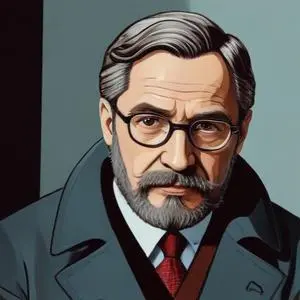
A Russian philosopher and theorist who developed Marxist theory and was a key figure in the Russian Revolution, known for his writings on dialectical materialism.
Georgi Plekhanov is renowned as the founder of the social democratic movement in Russia and one of the first Russians to identify as a Marxist. He is often regarded as the "father of Russian Marxism" due to his significant contributions to the development of Marxist theory and his unwavering dedication to the revolutionary movement.
Born on November 29, 1856, in Gudalovka, Tambov Governorate, Russia, Plekhanov came from a Tatar noble family of serf-owning landlords and minor government officials. Despite his privileged upbringing, Plekhanov rejected his social class and became a staunch advocate for social change. As a student, he became increasingly drawn to Marxist ideology, which would shape his future philosophy and political pursuits.
Plekhanov's philosophical contributions were instrumental in shaping the Russian Marxist movement. He believed that capitalism was a necessary stage in the development of society, paving the way for a socialist revolution. His work focused on the role of the proletariat in the revolutionary process, emphasizing the importance of class consciousness and the need for a unified working-class movement.
Plekhanov's impact on modern society is profound, as his work laid the foundation for the development of Russian Marxism. His philosophical contributions continue to influence socialist and communist movements worldwide. Despite his opposition to the Bolshevik state, Plekhanov was held in high esteem by the Communist Party of the Soviet Union following his death, recognizing his importance as a founding father of Russian Marxism.
Plekhanov's notable works include:
Georgi Plekhanov's legacy is complex and multifaceted. While he dedicated his life to the cause of socialism and Marxism, his opposition to the Bolshevik state and his rejection of democratic centralism led to controversy and criticism. Nevertheless, his philosophical contributions and his role as a founding father of Russian Marxism remain unparalleled.
Plekhanov's relationships with his contemporaries, including Vladimir Lenin and Leon Trotsky, were often tumultuous and marked by heated debates. Despite their political differences, Plekhanov maintained a deep respect for Lenin, acknowledging his intellectual prowess and dedication to the revolutionary cause.
Georgi Plekhanov passed away on May 30, 1918, in Finland, following a prolonged battle with tuberculosis. Despite his untimely death, Plekhanov's legacy continues to inspire and influence socialist and communist movements worldwide.
Born in 1870
Founder of the world's first socialist state, leading the Bolshevik Revolution and establishing the Soviet Union, known for his radical Marxist ideology and authoritarian rule.
Born in 1879
Founded the Red Army and played a crucial role in the Russian Revolution, shaping the course of modern communism. A key figure in 20th-century politics and ideology.
Born in 1818
A 19th-century philosopher who developed the theory of communism, arguing that capitalism would eventually be replaced by a socialist society. He's known for his critique of capitalism and the concept of class struggle.
Born in 1820
A 19th-century philosopher and economist who co-authored "The Communist Manifesto" with Karl Marx, shaping modern socialist and communist thought. He also wrote extensively on economics, history, and politics.
Born in 1814
A Russian philosopher and theorist who advocated for anarchism and the abolition of the state, and is known for his influence on the development of anarchist thought. His ideas emphasized individual freedom and the rejection of authority.
Born in 1856
A Russian philosopher and theorist who developed Marxist theory and was a key figure in the Russian Revolution, known for his writings on dialectical materialism.
Born in 1891
An Italian philosopher and politician who developed the concept of cultural hegemony, arguing that power is maintained through cultural and ideological means, rather than just economic or political control.
Born in 1871
A pioneering Marxist theorist and activist who advocated for workers' rights and criticized capitalism, known for her radical ideas on revolution and democracy.
