


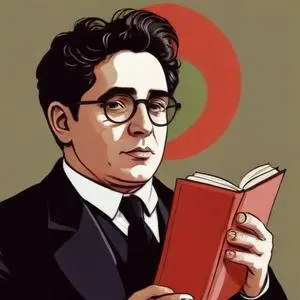
An Italian philosopher and politician who developed the concept of cultural hegemony, arguing that power is maintained through cultural and ideological means, rather than just economic or political control.
Antonio Gramsci, an Italian Marxist philosopher, linguist, and politician, is renowned for his groundbreaking theory of cultural hegemony, which posits that the ruling class maintains power through cultural institutions rather than force or coercion. His seminal work, the Prison Notebooks, composed of over 30 notebooks and 3,000 pages, is a testament to his profound contributions to 20th-century political theory.
Born on January 22, 1891, in Ales, Sardinia, Gramsci was the fourth of seven sons to Francesco Gramsci and Giuseppina Marcias. His family's modest means and his own frail health led him to pursue higher education, earning a scholarship to the University of Turin, where he studied philosophy and linguistics.
Gramsci's involvement in the Italian Socialist Party and his vocal criticism of Benito Mussolini's fascist regime led to his imprisonment in 1926. It was during his 11-year incarceration that he penned the bulk of his work, including the Prison Notebooks. His writings, though often fragmented and incomplete, demonstrate a profound understanding of Marxist theory, as well as a critical engagement with the works of Niccolò Machiavelli, Vilfredo Pareto, Georges Sorel, and Benedetto Croce.
Gramsci's most lasting contribution is his theory of cultural hegemony, which posits that the ruling class exercises control not through overt force, but rather through the dissemination of ideologies and cultural norms that shape public opinion and consent. This concept, which challenged traditional Marxist thought, has had far-reaching implications for understanding power dynamics in capitalist societies.
Gramsci's philosophical approach was characterized by a humanistic understanding of Marxism, which emphasized the role of human agency and praxis in shaping historical change. He rejected economic determinism, instead advocating for a nuanced understanding of the complex interplay between material conditions, ideology, and cultural practices.
Gramsci's ideas have had a profound impact on modern social and political thought, influencing scholars such as Stuart Hall, Edward Said, and Gayatri Chakravorty Spivak, among many others. His work has been applied to fields as diverse as cultural studies, critical theory, and postcolonialism.
Gramsci's life and work were marked by tumultuous times, including the rise of fascism in Italy and the subsequent decline of the Italian Communist Party. Despite these challenges, his ideas have endured, offering a powerful framework for understanding the complex dynamics of power and cultural production in modern societies.
"The crisis consists precisely in the fact that the old is dying and the new cannot be born; in this interregnum a great variety of morbid symptoms appears."
"The intellectuals are the dominant group in that they are the rulers of the ruling class."
Gramsci's work often invites comparison with that of his contemporaries, such as Georg Lukács and Vladimir Lenin. While sharing similarities with these thinkers, Gramsci's unique approach to cultural hegemony and his emphasis on human agency set him apart as a distinct voice in Marxist thought.
Gramsci's personal relationships, though often overshadowed by his intellectual pursuits, played a crucial role in shaping his life and work. His marriage to Julia Schucht, a Russian émigré, and his correspondence with Italian intellectuals and politicians offer a glimpse into the private life of this influential thinker.
| Year | Event |
|---|---|
| 1891 | Born in Ales, Sardinia |
| 1911 | Begins studying philosophy and linguistics at the University of Turin |
| 1914 | Becomes involved in the Italian Socialist Party |
| 1921 | Co-founds the Italian Communist Party |
| 1926 | Imprisoned for 11 years |
| 1937 | Dies in prison due to poor health |
Born in 1870
Founder of the world's first socialist state, leading the Bolshevik Revolution and establishing the Soviet Union, known for his radical Marxist ideology and authoritarian rule.
Born in 1885
A German philosopher who explored the concept of utopia and the human desire for a better world, influencing Marxist thought and critical theory.
Born in 1885
A Hungarian philosopher and critic who developed Marxist theory and critiqued capitalism, known for his ideas on reification and the role of class consciousness in shaping society.
Born in 1818
A 19th-century philosopher who developed the theory of communism, arguing that capitalism would eventually be replaced by a socialist society. He's known for his critique of capitalism and the concept of class struggle.
Born in 1820
A 19th-century philosopher and economist who co-authored "The Communist Manifesto" with Karl Marx, shaping modern socialist and communist thought. He also wrote extensively on economics, history, and politics.
Born in 1893
An Italian politician who played a crucial role in shaping the country's post-WWII government and was a key figure in the Italian Communist Party, known for his efforts to reform the justice system.
Born in 1469
Italian historian and philosopher who wrote "The Prince", a seminal work on politics and power that still influences modern leadership and governance today.
