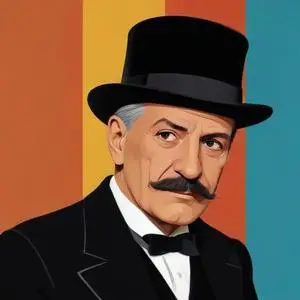
Vilfredo Pareto: The Father of Modern Economics and the Pareto Principle
A Pioneer in Economics and Beyond
Vilfredo Pareto, an Italian polymath, is renowned for his groundbreaking contributions to economics, sociology, civil engineering, philosophy, and mathematics. He is particularly celebrated for introducing the concept of Pareto efficiency and popularizing the Pareto principle, which reveals that approximately 20% of the population controls around 80% of the wealth.
Early Life and Education
Born on July 15, 1848, in Paris, France, Pareto was the son of an exiled noble Genoese family. His father, Raffaele Pareto, was an Italian civil engineer and Ligurian marquis who had left Italy due to the 1848 revolutions. Pareto's mother, Marie Metenier, was a French woman. In 1858, his family moved back to Italy, where he received a high-standard education. He attended the Istituto Tecnico Leardi, where Ferdinando Pio Rosellini, a prominent mathematician, was his professor. In 1869, Pareto earned a doctorate in engineering from the Technical School for Engineers (now the Polytechnic University of Turin) with a dissertation entitled "The Fundamental Principles of Equilibrium in Solid Bodies."
Career Highlights and Major Works
Pareto's academic pursuits led him to explore various fields, resulting in significant contributions:
- Cours d'économie politique (1896): This work introduced the concept of Pareto efficiency, which describes a state where resources are allocated in such a way that no individual can be made better off without making someone else worse off.
- Manuale di economia politica (1906): This manual is considered one of the most influential economics texts of the 20th century, and it laid the foundation for modern microeconomics.
- Pareto distribution: Pareto discovered that income follows a power-law probability distribution, where a small percentage of the population holds a disproportionately large percentage of the wealth.
Philosophical Contributions and Beliefs
Pareto's philosophical views were heavily influenced by his sociological and economic findings:
- Elite theory: Pareto believed that society is divided into elites and non-elites, with the elite holding power and influence.
- Critique of socialism and Marxism: Pareto argued that socialism and Marxism are flawed systems, as they fail to account for individual differences and the inevitability of inequality.
Personal Milestones and Key Life Events
Pareto's life was marked by significant milestones:
- 1889: He became a professor of economics at the University of Lausanne.
- 1900: He was appointed as a professor of political economy at the University of Rome.
- 1923: He passed away on August 19, leaving behind a legacy of groundbreaking contributions to various fields.
Influence on Modern Society
Pareto's work has had a profound impact on modern society:
- The Pareto principle is widely applied in business, economics, and policy-making to optimize resource allocation and identify areas of inefficiency.
- His concept of Pareto efficiency has influenced the development of modern microeconomics.
- Pareto's work has inspired countless researchers, economists, and policymakers, shaping the course of economic thought and policy decisions.
Legacy
Vilfredo Pareto's remarkable contributions to economics, sociology, and philosophy have cemented his place as one of the most influential thinkers of the 20th century. His work continues to inspire and influence scholars, policymakers, and business leaders, ensuring his legacy as a true pioneer in his fields.
FAQ
What is the Pareto principle, and how did Vilfredo Pareto discover it?
The Pareto principle, also known as the 80/20 rule, states that approximately 80% of effects come from 20% of causes. Vilfredo Pareto discovered this principle while studying the distribution of wealth in Italy. He noticed that 20% of the population owned 80% of the land.
What is Vilfredo Paretos contribution to economics?
Vilfredo Pareto made significant contributions to economics, including the development of the concept of Pareto efficiency, which states that a system is optimal when it is impossible to make one individual better off without making someone else worse off.
What was Vilfredo Paretos views on socialism?
Vilfredo Pareto was critical of socialism, believing that it was unrealistic and that it would lead to inequality and inefficiency. He argued that socialism would result in a concentration of power and wealth in the hands of a few individuals.
What are Vilfredo Paretos most famous works?
Vilfredo Paretos most famous works include Cours déconomie politique and Manuale di economia politica. His works are considered classics in the field of economics and have had a significant impact on modern economic thought.
What is Vilfredo Paretos legacy in economics?
Vilfredo Paretos legacy in economics is significant, and his ideas have influenced many economists, including Joseph Schumpeter and Friedrich Hayek. His concept of Pareto efficiency is still widely used in economics today.