


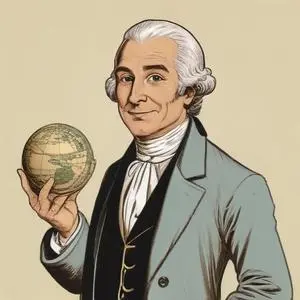
Franois Quesnay, a French economist and physician, is best known for publishing the Tableau économique (Economic Table) in 1758, a groundbreaking work that laid the foundations of modern economic thought. This seminal work is considered one of the first important contributions to economic theory, describing the workings of the economy in an analytical and systematic way.
Quesnay was born on June 4, 1694, in Mere, near Versailles, France. He was the son of an advocate and small landed proprietor. At the age of 16, he was apprenticed to a surgeon and later went on to study medicine and surgery in Paris. After qualifying as a master surgeon, he settled in Mantes to practice medicine.
In 1737, Quesnay was appointed perpetual secretary of the Academy of Surgery, founded by Franois Gigot de la Peyronie. He later became surgeon-in-ordinary to King Louis XV and eventually, the king's first consulting physician. Quesnay's apartments were located on the entresol floor of the Palace of Versailles, which became the site of frequent meetings with other intellectuals, earning the name "Réunions de l'entresol".
Quesnay's Tableau économique is considered his magnum opus. It presents a comprehensive and systematic analysis of the economy, introducing concepts such as the circular flow of income, the importance of agriculture, and the role of the entrepreneur. This work influenced many prominent economists, including Adam Smith and Karl Marx.
Quesnay was a key figure in the Physiocratic school of economics, a group of thinkers who believed in the importance of agriculture and the natural order of the economy. They advocated for limited government intervention and the promotion of free trade and competition.
In 1767, Quesnay wrote Le Despotisme de la Chine, a treatise on Chinese politics and society. In this work, he expressed his support for enlightened despotism, a system of government in which a benevolent ruler makes decisions for the good of the people.
Franois Quesnay's contributions to economics and his influence on modern economic thought are undeniable. He is considered one of the founders of modern economics, and his ideas continue to shape economic policy and theory to this day.
61 Years Old
A lawyer and politician who served in the U.S. House of Representatives from 1987 to 1997, known for his moderate Republican views and advocacy for environmental issues.
Born in 1767
A French economist and academic who developed the concept of entrepreneurship and is credited with coining the term "economist," making significant contributions to classical economics. He is also known for Say's Law, which states that "supply creates its own demand."
Born in 1694
A witty and insightful 18th-century writer and philosopher who used satire to critique societal norms and advocate for reason, tolerance, and human rights.
Born in 1712
A pioneering thinker who shaped modern democracy and education with his ideas on social contracts, general will, and the importance of early childhood education. His writings influenced the French Revolution and modern political thought.
Born in 1724
Developed influential philosophical frameworks, such as the Critique of Pure Reason, that shaped modern Western thought on ethics, morality, and human understanding.
Born in 1711
A Scottish Enlightenment thinker who developed influential ideas on morality, ethics, and human nature, and is considered one of the most important figures in the history of Western philosophy.
Born in 1632
A 17th-century thinker who laid the groundwork for modern democracy, arguing that governments derive their power from the people and that individuals have inherent rights to life, liberty, and property.
