


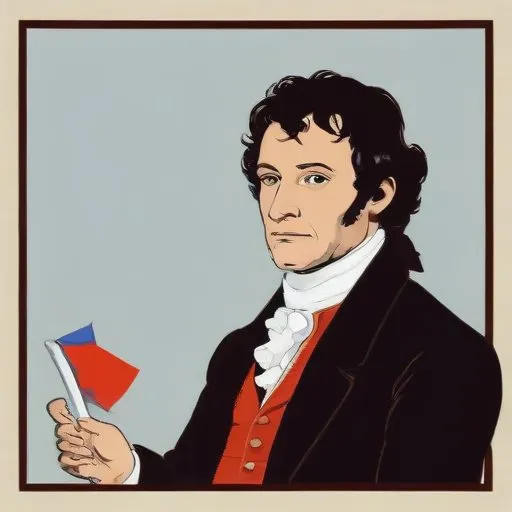
A French economist and academic who developed the concept of entrepreneurship and is credited with coining the term "economist," making significant contributions to classical economics. He is also known for Say's Law, which states that "supply creates its own demand."
Known as the father of entrepreneurship, Jean-Baptiste Say was a French economist and businessman who advocated for competition, free trade, and lifting restraints on business. He is best remembered for his famous concept, Say's Law, which states that "production precedes consumption" and that economic growth is driven by supply, not demand.
Born on January 5, 1767, in Lyon, France, Say came from a Protestant family that had fled to Geneva due to the revocation of the Edict of Nantes. His father, Jean-Etienne Say, intended for him to pursue a commercial career, and in 1785, he was sent to England to complete his education.
During his time in England, Say lodged in Croydon and later in Fulham, where he was employed by two London-based firms of sugar merchants, James Baillie & Co. and Samuel and William Hibbert. This experience laid the foundation for his future economic theories.
In 1803, Say published his magnum opus, Traité d'économie politique, which introduced the concept of Say's Law. This idea challenged the traditional view that economic growth is driven by demand, instead arguing that production is the driving force behind economic activity.
Say's Law was a groundbreaking concept that emphasized the importance of entrepreneurship and innovation in driving economic growth. It states that "a product is no sooner created, than it, from that instant, affords a market for other products to the full extent of its own value."
Say was one of the first economists to study entrepreneurship and conceptualize entrepreneurs as organizers and leaders of the economy. He believed that entrepreneurs play a crucial role in driving economic growth by identifying opportunities, taking risks, and creating new products and services.
In addition to his theoretical contributions, Say was also involved in the development of the École Spéciale de Commerce et d'Industrie, historically the first business school to be established.
Say's ideas have had a lasting impact on modern economic thought and policy. His advocacy for free trade and competition paved the way for the development of neoliberalism and the rise of global trade.
Today, Say's Law remains a fundamental concept in economics, and his emphasis on entrepreneurship and innovation continues to inspire business leaders and policymakers around the world.
Through his work and ideas, Jean-Baptiste Say left an indelible mark on the field of economics, and his legacy continues to shape our understanding of entrepreneurship, innovation, and economic growth.
61 Years Old
A lawyer and politician who served in the U.S. House of Representatives from 1987 to 1997, known for his moderate Republican views and advocacy for environmental issues.
Born in 1772
A British economist and politician who developed the concept of comparative advantage, which revolutionized international trade and shaped modern economic theory.
Born in 1806
A prominent 19th-century thinker who championed individual liberty, free speech, and women's rights, and is best known for his influential book "On Liberty".
Born in 1818
A 19th-century philosopher who developed the theory of communism, arguing that capitalism would eventually be replaced by a socialist society. He's known for his critique of capitalism and the concept of class struggle.
Born in 1899
Austrian economist and philosopher who championed free market capitalism and limited government intervention, warning of the dangers of socialism and totalitarianism. His work influenced economic policy and shaped modern libertarian thought.
Born in 1912
A Nobel Prize-winning economist who championed free market capitalism and limited government intervention, known for his advocacy of laissez-faire economics and influential writings on monetary policy.
Born in 1883
A pioneering economist who revolutionized modern economic theory with his groundbreaking ideas on government intervention and fiscal policy, shaping global economic policies.
Born in 1834
Developed the concept of general equilibrium theory, which describes how markets reach equilibrium, and is considered one of the founders of the neoclassical school of economics.
