


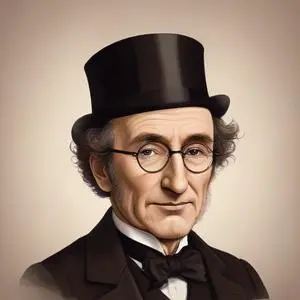
A prominent 19th-century thinker who championed individual liberty, free speech, and women's rights, and is best known for his influential book "On Liberty".
John Stuart Mill, renowned as one of the most influential thinkers in the history of liberalism, made significant contributions to social theory, political theory, and political economy. He is best known for conceiving liberty as the justification for individual freedom, opposing unlimited state and social control.
Born on May 20, 1806, in Pentonville, London, Mill was the eldest son of Harriet Barrow and Scottish philosopher, historian, and economist James Mill. His father, a follower of Jeremy Bentham and adherent of associationism, had a clear intention to create a genius intellect that would carry on the cause of utilitarianism.
Mill's education was extremely rigorous, and he was deliberately shielded from association with children his own age, except his siblings. He was taught Greek at the age of three and had read Aesop's Fables by eight. This intense educational regime laid the foundation for his later intellectual pursuits.
Mill was a proponent of utilitarianism, an ethical theory developed by Jeremy Bentham. He believed that individual liberty was essential for human flourishing and that the state should not impose its will on individuals. His philosophical contributions extended to the investigation of scientific methodology, although he relied on the writings of others, such as William Whewell, John Herschel, and Auguste Comte.
Mill's most notable works include:
Mill's philosophical ideas have had a profound impact on modern society. He was one of the first to advocate for women's suffrage, and his work on individual liberty has influenced political thought and activism globally. His contributions to liberalism have shaped the development of democratic governments and the protection of human rights.
Mill was a member of the Liberal Party and served as a Member of Parliament from 1865 to 1868. During his tenure, he advocated for women's suffrage, becoming the second person to do so after Henry Hunt in 1832.
In 1851, Mill married Harriet Taylor, a campaigner for women's rights, and the couple had a deep and intellectual partnership until her death in 1858. Mill's relationships and personal experiences significantly influenced his philosophical ideas and advocacy for women's empowerment.
John Stuart Mill's legacy extends far beyond his philosophical contributions. He has inspired generations of thinkers, politicians, and activists to fight for individual liberty, human rights, and social justice. His work continues to influence political theory, economic policy, and social reform, ensuring that his ideas remain relevant and vital in the 21st century.
As the Stanford Encyclopedia of Philosophy aptly describes him, Mill is indeed the most influential English-speaking philosopher of the 19th century, leaving behind a rich legacy that will continue to shape the course of human history.
Born in 1748
Developed the concept of utilitarianism, which aims to maximize overall happiness and well-being, and is considered the founder of modern welfare economics.
Born in 1773
A Scottish historian, economist, and philosopher who contributed significantly to the development of classical economics, utilitarianism, and the British East India Company, shaping modern economic thought.
Born in 1807
A pioneering feminist and philosopher who advocated for women's rights and education, and was a significant influence on her husband John Stuart Mill's work.
Born in 1772
A British economist and politician who developed the concept of comparative advantage, which revolutionized international trade and shaped modern economic theory.
61 Years Old
A lawyer and politician who served in the U.S. House of Representatives from 1987 to 1997, known for his moderate Republican views and advocacy for environmental issues.
Born in 1724
Developed influential philosophical frameworks, such as the Critique of Pure Reason, that shaped modern Western thought on ethics, morality, and human understanding.
Born in 1798
Developed the concept of sociology and coined the term, creating a framework for understanding social structures and relationships. Known for his Positivism philosophy, emphasizing scientific observation and empirical evidence.
Born in 1795
A 19th-century historian, philosopher, and academic who wrote influential works on history, politics, and society, particularly "The French Revolution" and "On Heroes, Hero-Worship, and The Heroic in History".
