


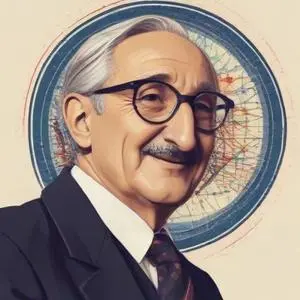
Austrian economist and philosopher who championed free market capitalism and limited government intervention, warning of the dangers of socialism and totalitarianism. His work influenced economic policy and shaped modern libertarian thought.
Friedrich Hayek is renowned for his groundbreaking contributions to economics, politics, and philosophy, earning him the 1974 Nobel Memorial Prize in Economic Sciences. His seminal work, The Road to Serfdom, remains a timeless classic, warning against the dangers of government control and advocating for individual freedom and limited state intervention.
Born on May 8, 1899, in Vienna, Austria, Hayek was shaped by his experiences during World War I, which sparked his interest in economics and his desire to prevent similar conflicts. He earned doctoral degrees in law and political science from the University of Vienna, setting the stage for his illustrious academic career.
Hayek's work was deeply rooted in the Austrian School of Economics, which emphasizes individual decision-making, market processes, and limited government intervention. As the cofounder of the Mont Pelerin Society, he played a pivotal role in reviving classical liberalism in the post-war era, fostering a community of like-minded scholars and thinkers.
Hayek's extensive bibliography includes The Pure Theory of Capital, The Constitution of Liberty, and Law, Legislation and Liberty, showcasing his profound understanding of market dynamics, the role of prices in communicating information, and the importance of individual freedom.
Hayek's ideas have had a profound impact on modern society, shaping the thinking of politicians, economists, and philosophers across the political spectrum. His warnings about the dangers of socialism and the importance of individual freedom continue to resonate in contemporary debates.
Hayek's life was marked by significant personal and professional milestones, including:
Friedrich Hayek's legacy extends far beyond his academic achievements, as his ideas continue to inspire and shape the thinking of individuals and governments worldwide. His commitment to individual freedom, limited government intervention, and market processes has left an indelible mark on modern economic thought.
As we reflect on Hayek's remarkable life and work, we are reminded of the importance of protecting individual liberty and promoting economic freedom. His timeless message continues to resonate, serving as a beacon of hope for a brighter, more prosperous future.
Born in 1912
A Nobel Prize-winning economist who championed free market capitalism and limited government intervention, known for his advocacy of laissez-faire economics and influential writings on monetary policy.
Born in 1881
A pioneer of Austrian economics, he developed the concept of praxeology, which focuses on human action and its consequences, and is known for his critiques of socialism and central planning.
Born in 1905
Russian-born American novelist and philosopher who wrote influential novels like "The Fountainhead" and "Atlas Shrugged", promoting individualism and capitalism.
Born in 1911
The charismatic leader who championed conservative policies, helped end the Cold War, and is often credited with restoring American pride and optimism. He's also remembered for his folksy, actor-honed communication style.
Born in 1925
The first female Prime Minister of the United Kingdom, serving from 1979 to 1990, known for her conservative policies and leadership during the Falklands War.
Born in 1926
Former Chairman of the Federal Reserve, guiding the US economy through periods of growth and crisis, and known for his influence on monetary policy.
95 Years Old
A pioneer in applying economic theory to social issues, he's most known for his work on human capital, crime and punishment, and the economics of the family.
87 Years Old
A Nobel Prize-winning economist and academic who developed the Efficient Market Hypothesis, which revolutionized our understanding of stock markets and investments.
