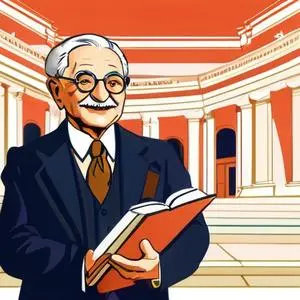
Ludwig von Mises: The Austrian Sage of Liberty
The Champion of Classical Liberalism
Ludwig von Mises, a giant of 20th-century economics, is renowned for his unwavering advocacy of classical liberalism and his scathing critiques of socialism and communism. Through his prolific writings and teachings, Mises shaped the libertarian movement, inspiring generations of economists, philosophers, and politicians to embrace the principles of individual liberty and limited government.
Early Life and Education
Born on September 29, 1881, in Lviv, Ukraine (then part of Austria-Hungary), Mises was raised in a Jewish family with a noble lineage. His father, Arthur Edler von Mises, was a construction engineer, and his mother, Adele, was a niece of a prominent Austrian Parliament deputy. Mises' early life was marked by linguistic and cultural diversity, with fluency in five languages by the age of 12. He pursued his academic interests in law and economics at the University of Vienna, where he earned his Ph.D. in 1906.
The Emergence of Praxeology
Mises' magnum opus,
Human Action (1949), cemented his reputation as a pioneer of praxeology, the study of human action and decision-making. This groundbreaking approach rejected the notion of economic activity as a mechanical process, instead emphasizing the significance of individual choice and subjective value. Mises' praxeological framework has been instrumental in shaping modern libertarian thought and continues to influence economists, philosophers, and policymakers worldwide.
The Private Seminar and Its Illustrious Alumni
From 1920 to 1934, Mises conducted his legendary Private Seminar in Vienna, attracting a diverse group of scholars, including
Friedrich Hayek, Oskar Morgenstern, and Fritz Machlup. This intellectual powerhouse incubated innovative ideas and fostered a network of influential thinkers who would go on to shape the course of economic thought in the 20th century.
Fleeing Tyranny and Embracing Freedom
In 1940, Mises fled Nazi-occupied Austria, eventually settling in the United States, where he became a naturalized citizen in 1946. His arrival marked a new chapter in his life, during which he continued to write and teach, spreading his libertarian message to American audiences.
Influence on Modern Society
Mises' work has inspired a wide range of individuals, from Nobel laureates like Friedrich Hayek and
Milton Friedman to politicians like Ron Paul and libertarians across the globe. His ideas have permeated the realms of politics, economics, and philosophy, shaping the discourse on individual freedom, limited government, and free markets.
Major Works and Career Highlights
- The Theory of Money and Credit (1912): A seminal work on monetary theory and the business cycle
- Socialism (1922): A scathing critique of socialism and its economic flaws
- Liberalism (1927): A comprehensive treatise on classical liberalism and its principles
- Human Action (1949): A magnum opus on praxeology and the foundations of economic science
- New York University professor (1945-1969) and influential lectures at various institutions
Philosophical Contributions and Beliefs
Mises' philosophical contributions extend beyond economics, encompassing a broader vision of human liberty and the role of government. He was a staunch advocate for individual rights, limited government, and the free market, believing that these principles were essential for human flourishing and societal progress.
Personal Milestones and Key Life Events
- Received the Austrian nobiliary title "Edler von" in 1887
- Married Margit Herzfeld in 1938, with whom he had no children
- Became a U.S. citizen in 1946
- Passed away on October 10, 1973, at the age of 92
Legacy and Impact
Ludwig von Mises' profound influence on modern economics, politics, and philosophy continues to reverberate through the ages. His ideas have inspired generations of scholars, policymakers, and thinkers, cementing his status as one of the most important and enduring voices in the pursuit of liberty and prosperity.
FAQ
What are the main contributions of Ludwig von Mises to economics?
Ludwig von Mises made significant contributions to economics, including the development of the Austrian School of economics, which emphasizes individual freedom and limited government intervention. He is also known for his work on praxeology, the study of human action.
What is the Austrian School of economics, and how did Ludwig von Mises influence it?
The Austrian School of economics is a tradition of economic thought that emphasizes individual freedom, limited government intervention, and the importance of individual decision-making. Ludwig von Mises was a key figure in the development of this school, and his work had a significant influence on its principles and ideas.
What are some of Ludwig von Mises most notable books?
Ludwig von Mises wrote several notable books, including Human Action, Socialism, and Theory and History. These works provide a comprehensive overview of his economic and philosophical ideas, and are still widely read and studied today.
How did Ludwig von Mises background influence his economic views?
Ludwig von Mises was born in Austria-Hungary and lived through World War I and the rise of socialism and fascism in Europe. These experiences shaped his economic views, leading him to advocate for individual freedom and limited government intervention.
What is Ludwig von Mises legacy in modern economics?
Ludwig von Mises ideas continue to influence modern economics, particularly in the areas of libertarianism and Austrian economics. His work has inspired many economists and thinkers, including Milton Friedman and Friedrich Hayek, and remains an important part of economic thought today.