


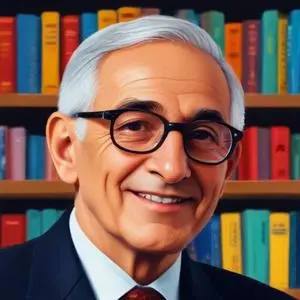
A pioneer in Austrian economics, he's renowned for his work on entrepreneurship, opportunity discovery, and market process theory. His ideas have shaped modern economic thought and policy.
Renowned economist, historian, and rabbi, Israel Kirzner is best known for his groundbreaking work in integrating entrepreneurship into neoclassical economics, and for being a leading authority on Ludwig von Mises' thinking and methodology. His research has been instrumental in shaping the field of entrepreneurship studies, earning him the Global Award for Entrepreneurship Research in 2006.
Born on February 13, 1930, in London, England, Kirzner was the son of a well-known rabbi and Talmudist. He spent part of his early years in South Africa, where he studied at the University of Cape Town from 1947 to 1948. Later, he moved to the United States, where he received his B.A. summa cum laude from Brooklyn College in 1954, and an MBA in 1955 and Ph.D. in 1957 from New York University.
Kirzner is emeritus professor of economics at New York University, where he taught for many years. His research focus on entrepreneurship economics has been widely recognized, and his book, Competition and Entrepreneurship, is a seminal work in the field. In it, Kirzner critiques neoclassical theory for its preoccupation with the model of perfect competition, neglecting the important role of the entrepreneur in economic life.
His work integrating entrepreneurial action into neoclassical economics has been more widely accepted than nearly any other Austrian idea of the late twentieth century. Kirzner's ideas have greatly impacted the field of entrepreneurship studies, and he is often associated with the opportunity discovery view. However, a closer reading of his work reveals a more nuanced approach, with two distinct camps: one focusing on discovery and the other on creation.
In recognition of his contributions to the field of entrepreneurship, Kirzner received the Global Award for Entrepreneurship Research in 2006. This prestigious award acknowledges his work in developing the economic theory emphasizing the importance of the entrepreneur for economic growth and the functioning of the capitalist process.
Kirzner's work is deeply rooted in the Austrian School of economics, which emphasizes the importance of individual decision-making and entrepreneurial action in shaping economic outcomes. He believes that entrepreneurship is a key driver of economic growth and innovation, and that it is essential to understand the role of the entrepreneur in creating value and driving progress.
Kirzner's work has had a profound impact on the field of entrepreneurship studies, and his ideas continue to influence scholars and policymakers around the world. His research has helped to shape our understanding of the entrepreneurial process, and has paved the way for further research into the role of entrepreneurship in economic development.
In addition to his academic achievements, Kirzner is also an ordained Rabbi. This unique combination of expertise in economics and theology has given him a distinct perspective on the role of entrepreneurship in society, and has informed his research and teaching throughout his career.
Kirzner's work has had a significant impact on modern society, shaping our understanding of the entrepreneurial process and its role in driving economic growth and innovation. His ideas have influenced policymakers and business leaders around the world, and continue to shape the way we think about entrepreneurship and economic development.
Kirzner's work is often compared to that of Joseph Schumpeter, another influential economist who studied entrepreneurship. While both scholars recognized the importance of entrepreneurship in economic development, Kirzner's work is more focused on the opportunity discovery view, whereas Schumpeter's work is more focused on the creative destruction process.
One of Kirzner's most famous quotes is: "The entrepreneur is not simply a risk-taker, but a discoverer of opportunities." This quote captures the essence of his work, highlighting the importance of entrepreneurial discovery in driving economic growth and innovation.
Did you know that Kirzner's work has been translated into multiple languages, including Spanish, French, and Portuguese?
As the global economy continues to evolve, Kirzner's work on entrepreneurship and economic growth is likely to remain highly relevant. His ideas will continue to shape our understanding of the entrepreneurial process, and inform policymakers and business leaders as they strive to promote economic growth and innovation.
Born in 1912
A Nobel Prize-winning economist who championed free market capitalism and limited government intervention, known for his advocacy of laissez-faire economics and influential writings on monetary policy.
Born in 1899
Austrian economist and philosopher who championed free market capitalism and limited government intervention, warning of the dangers of socialism and totalitarianism. His work influenced economic policy and shaped modern libertarian thought.
Born in 1881
A pioneer of Austrian economics, he developed the concept of praxeology, which focuses on human action and its consequences, and is known for his critiques of socialism and central planning.
Born in 1926
A prominent figure in the Austrian School of economics, known for his libertarian and anarchist views, and his work on the history of economic thought.
95 Years Old
A pioneer in applying economic theory to social issues, he's most known for his work on human capital, crime and punishment, and the economics of the family.
87 Years Old
A Nobel Prize-winning economist and academic who developed the Efficient Market Hypothesis, which revolutionized our understanding of stock markets and investments.
85 Years Old
Developed the Black-Scholes model, a groundbreaking formula for pricing options and derivatives, revolutionizing financial markets and earning a Nobel Prize in Economics. This work has had a lasting impact on modern finance and investment strategies.
