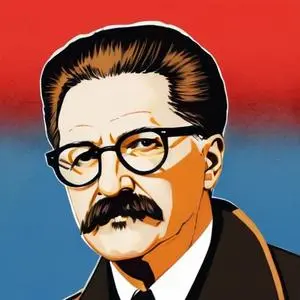
Leon Trotsky: The Revolutionary Titan of Soviet Politics
A Life of Revolutionary Ferment
Leon Trotsky, born Lev Davidovich Bronstein, was a Russian revolutionary, Soviet politician, and political theorist who left an indelible mark on the 20th century. As one of the most prominent figures in Soviet politics, Trotsky played a crucial role in shaping the course of the Russian Revolution, founding the Red Army, and leading the Soviet Union's withdrawal from World War I.
Early Life and Radicalization
Born on November 7, 1879, in Yanovka, Ukraine, Trotsky was raised in a wealthy Jewish family in the Russian Empire. His early life was marked by a fascination with literature and an affinity for radical ideas. In 1898, Trotsky joined the Russian Social Democratic Labour Party, marking the beginning of his lifelong commitment to Marxism.
The Rise to Prominence
Trotsky's revolutionary activities led to his arrest and exile to Siberia in 1900. However, he escaped to London in 1902, where he met
Vladimir Lenin and began writing for the party's newspaper, Iskra. Trotsky's eloquence and conviction soon made him a prominent figure in Soviet politics. He played a key role in the 1905 Revolution, becoming chairman of the Saint Petersburg Soviet, and later, a leader of the Petrograd Soviet during the October Revolution.
The Trotsky-Lenin Alliance
Trotsky's partnership with Lenin was instrumental in shaping the Soviet government. As chairman of the Petrograd Soviet, Trotsky played a crucial role in the October Revolution that overthrew the Provisional Government. Lenin appointed Trotsky as the People's Commissar for Foreign Affairs, where he led negotiations for the Treaty of Brest-Litovsk, securing Russia's withdrawal from World War I.
Founding the Red Army
In 1918, Trotsky became the People's Commissar for Military and Naval Affairs, responsible for founding the Red Army. Under his leadership, the Red Army triumphed in the Russian Civil War, securing the Soviet state's survival.
Trotskyism and Ideological Legacy
Trotsky's writings and ideas inspired a distinct school of Marxism known as Trotskyism. His philosophy emphasized the need for international socialist revolution, criticizing Stalin's bureaucratic authoritarianism. Trotsky's legacy continues to influence socialist and Marxist thought, with his works remaining a testament to his unwavering commitment to revolution and social justice.
Exile, Assassination, and Legacy
In 1929, Stalin exiled Trotsky from the Soviet Union, forcing him to flee to Turkey, France, and eventually Mexico. On August 21, 1940, Trotsky was assassinated in Mexico City by Ramón Mercader, a Spanish-born Soviet agent. Despite his tragic end, Trotsky's impact on Soviet politics and Marxist thought remains profound, inspiring generations of revolutionaries and thinkers.
Key Works and Writings
- My Life (1930) - Trotsky's autobiography
- The History of the Russian Revolution (1930) - a three-volume set detailing the Russian Revolution
- The Revolution Betrayed (1937) - a critical analysis of Stalin's Soviet Union
Philosophical Contributions and Beliefs
Trotsky's thought was deeply rooted in Marxism and Leninism. He believed in the need for international socialist revolution, criticizing Stalin's bureaucratic authoritarianism. Trotsky advocated for a decentralized, democratic Soviet state, emphasizing the importance of worker self-management and international solidarity.
Personal Milestones and Key Life Events
- 1902: Escaped to London, where he met Lenin and began writing for Iskra
- 1905: Played a key role in the Russian Revolution, becoming chairman of the Saint Petersburg Soviet
- 1917: Returned to Russia and joined the Bolsheviks, playing a crucial role in the October Revolution
- 1929: Exiled from the Soviet Union by Stalin
- 1940: Assassinated in Mexico City by Ramón Mercader
Influence on Modern Society
Trotsky's ideas and writings continue to influence socialist and Marxist thought. His critiques of Stalinism and advocacy for democratic socialism remain relevant today. Trotsky's legacy serves as a testament to the power of revolutionary ideas and the enduring struggle for social justice.
FAQ
What was Leon Trotskys role in the Russian Revolution?
Leon Trotsky was a key figure in the Russian Revolution, playing a crucial role in the Bolshevik seizure of power in 1917. He was a skilled orator, writer, and strategist, and his organizational skills were instrumental in the Revolutions success.
How did Leon Trotskys views on communism differ from Stalins?
Leon Trotskys views on communism differed significantly from those of Joseph Stalin. Trotsky advocated for a more decentralized, democratic approach to socialism, while Stalin favored a more authoritarian regime. This ideological rift ultimately led to Trotskys exile and Stalins rise to power.
What was Leon Trotskys relationship with Vladimir Lenin?
Leon Trotsky had a complex and often tumultuous relationship with Vladimir Lenin. Initially, the two were close allies, but they later clashed over ideological differences. Despite this, Trotsky remained devoted to Lenins ideals and played a key role in implementing his policies.
What was Leon Trotskys role in the formation of the Red Army?
Leon Trotsky was instrumental in the formation of the Red Army, which he founded in 1918. He was an effective military leader, using his organizational skills to mobilize troops and defeat the White Army in the Russian Civil War.
What is Leon Trotskys legacy in modern politics?
Leon Trotskys legacy in modern politics is that of a visionary and a champion of democratic socialism. His ideas about decentralized power, workers self-management, and the importance of civil liberties continue to influence left-wing movements around the world.