


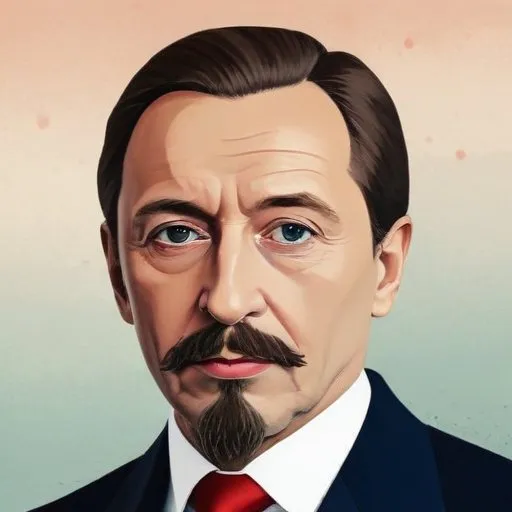
Founder of the Soviet secret police, known for his role in establishing the Cheka, a precursor to the KGB, and implementing repressive policies during the Russian Revolution.
Felix Dzerzhinsky, nicknamed "Iron Felix," was a Soviet revolutionary and politician who led the first two Soviet secret police organizations, the Cheka and the OGPU, from 1917 until his death in 1926. He is renowned for establishing state security organs for the Bolshevik regime and playing a pivotal role in the Red Terror, a campaign of mass arrests, detentions, and executions that marked the early years of the Soviet Union.
Born on September 11, 1877, in the Minsk Governorate of the Russian Empire (now in Belarus), Dzerzhinsky was a member of a Polish noble family. He was drawn to revolutionary politics from a young age, joining the Social Democracy of the Kingdom of Poland and Lithuania party and actively participating in protests and uprisings in Kaunas and Warsaw.
His involvement in revolutionary activities led to frequent arrests and exiles to Siberia, from which he managed to escape every time. Despite being pursued by the tsarist secret police, the Okhrana, Dzerzhinsky remained committed to the cause, studying the workings of the Okhrana to better understand the tactics of the opposition.
After a final arrest in 1912, Dzerzhinsky was imprisoned until the February Revolution of 1917, which marked the end of the Romanov dynasty and led to the rise of the Bolsheviks. He joined Vladimir Lenin's Bolshevik party and played an active role in the October Revolution, which brought the Bolsheviks to power.
In December 1917, Lenin appointed Dzerzhinsky as the head of the newly established All-Russian Extraordinary Commission (Cheka), tasking him with suppressing counterrevolutionary activities in Soviet Russia. This marked the beginning of Dzerzhinsky's tenure as the leader of the Soviet state security organs, a position that would shape the course of Soviet history.
During the Russian Civil War, the Cheka's authority expanded, and Dzerzhinsky oversaw a campaign of mass arrests, detentions, and executions known as the Red Terror. It is estimated that between 50,000 to 200,000 people lost their lives during this period.
In 1922, the Cheka was reorganized as the State Political Directorate (GPU), and later as the Joint State Political Directorate (OGPU) in 1923, with Dzerzhinsky at the helm. Under his leadership, the Soviet state security organs became increasingly powerful, with the OGPU responsible for enforcing Soviet policies, suppressing dissent, and maintaining state control.
Felix Dzerzhinsky's legacy is deeply controversial, with many viewing him as a ruthless and brutal leader responsible for the deaths of thousands. Others see him as a dedicated revolutionary who played a crucial role in establishing and maintaining the Soviet regime.
In the context of Soviet history, Dzerzhinsky's role cannot be overstated. He was a key figure in shaping the Soviet state and its relationship with its citizens. His vision of state security and control would influence Soviet politics for decades to come, casting a long shadow over the Soviet Union and beyond.
"We stand for the organization of terror, and we apologize for nothing."
Felix Dzerzhinsky's life and legacy serve as a testament to the complexities and controversies of Soviet history. As the "Iron-Fisted Architect of Soviet State Security," he left an indelible mark on the Soviet Union and its people, shaping the course of history in ways both profound and far-reaching.
Born in 1870
Founder of the world's first socialist state, leading the Bolshevik Revolution and establishing the Soviet Union, known for his radical Marxist ideology and authoritarian rule.
Born in 1878
The Soviet Union's ruthless leader who ruled with an iron fist, implementing policies that led to widespread famine and purges, while also playing a crucial role in defeating Nazi Germany in World War II.
Born in 1879
Founded the Red Army and played a crucial role in the Russian Revolution, shaping the course of modern communism. A key figure in 20th-century politics and ideology.
Born in 1875
The first Head of State of the Soviet Union, serving from 1919 to 1946, known for his role in establishing the Soviet government and implementing Stalin's policies. He was a key figure in the Soviet leadership during World War II.
Born in 1888
A prominent figure in the Russian Revolution, he was a key architect of the Soviet economy and a vocal critic of Stalin's regime, ultimately falling victim to his purges.
Born in 1881
Premier of Russia during the early Soviet era, known for his moderate policies and opposition to Stalin's rise to power.
Born in 1899
Soviet Union's ruthless secret police chief, responsible for millions of deaths and brutal suppressions during Stalin's regime, known for his cunning and feared reputation.
