


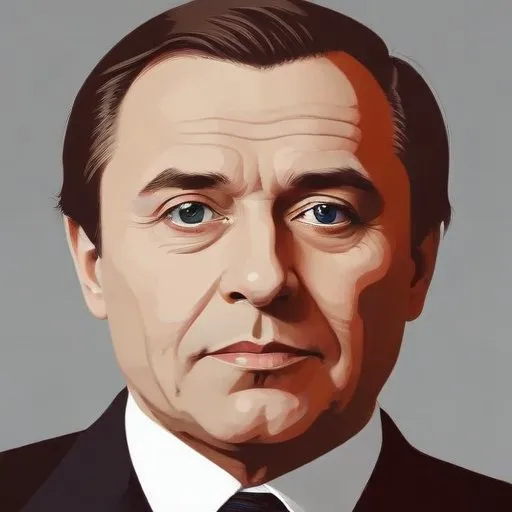
Premier of Russia during the early Soviet era, known for his moderate policies and opposition to Stalin's rise to power.
Alexei Ivanovich Rykov, a prominent Russian Bolshevik revolutionary and Soviet politician, is best known for serving as the premier of Russia and the Soviet Union from 1924 to 1929 and 1924 to 1930, respectively. His leadership played a significant role in shaping the country's economy, politics, and society during the tumultuous period following the Russian Revolution.
Born on February 25, 1881, in Saratov, Russia, Rykov joined the Russian Social Democratic Labour Party in 1898, and later became a member of the Bolshevik faction led by Vladimir Lenin. He actively participated in the 1905 Russian Revolution and was elected to the Bolshevik Party Central Committee in 1917.
After the October Revolution, Rykov held various positions in the new Soviet government, including Peoples Commissar for Internal Affairs. During the Russian Civil War, he oversaw the implementation of the War Communism economic policy and played a crucial role in distributing food to the Red Army and Navy.
Following Lenin's incapacitation in 1923, Rykov, along with Lev Kamenev, was elected as deputy chairman to Lenin. After Lenin's death in 1924, Rykov was chosen as the premier of both the Russian Soviet Federative Socialist Republic and the Soviet Union.
During his tenure as premier, Rykov implemented various policies aimed at stabilizing the economy and rebuilding the country. He introduced the New Economic Policy (NEP), which allowed for limited private enterprise and market-based reforms. His leadership also saw the establishment of the State Planning Committee (Gosplan) and the development of the country's first five-year plan.
Rykov's moderate stance and criticism of Stalin's policies eventually led to his downfall. He was accused of treason and sabotage during Stalin's show trials and was executed on March 15, 1938.
Rykov's contributions to the Soviet Union's development, particularly during the early years of the revolution, are undeniable. His leadership played a significant role in shaping the country's economy, politics, and society. Despite his tragic fall from power and eventual execution, Rykov's legacy serves as a testament to the complexities and challenges of the Soviet era.
Rykov was known for his moderate personality and his ability to navigate the complex web of alliances and rivalries within the Bolshevik Party. He developed close relationships with other prominent leaders, including Lenin and Kamenev.
Rykov's life and career can be seen as a reflection of the tumultuous era in which he lived. His rise to power, his policies, and his eventual fall from grace are all closely tied to the broader historical context of the Russian Revolution and the early years of the Soviet Union. A comparative analysis with contemporaries such as Lenin and Stalin provides valuable insights into the complex dynamics of the Soviet leadership.
Rykov's legacy is often overshadowed by the controversies surrounding his trial and execution. However, a closer examination of his life and career reveals a complex figure who played a significant role in shaping the Soviet Union's development.
"The revolution is not a dinner party, nor is it a literary composition, nor a painting, nor a piece of embroidery; it cannot be so refined, so leisurely and gentle, so temperate, kind, courteous, restrained, and magnanimous." - Rykov, 1923
Born in 1870
Founder of the world's first socialist state, leading the Bolshevik Revolution and establishing the Soviet Union, known for his radical Marxist ideology and authoritarian rule.
Born in 1878
The Soviet Union's ruthless leader who ruled with an iron fist, implementing policies that led to widespread famine and purges, while also playing a crucial role in defeating Nazi Germany in World War II.
Born in 1879
Founded the Red Army and played a crucial role in the Russian Revolution, shaping the course of modern communism. A key figure in 20th-century politics and ideology.
Born in 1888
A prominent figure in the Russian Revolution, he was a key architect of the Soviet economy and a vocal critic of Stalin's regime, ultimately falling victim to his purges.
Born in 1880
A high-ranking Soviet politician who served on the Politburo, playing a key role in shaping the Soviet Union's economy and politics during the 1920s and 1930s. He's known for his opposition to Stalin's policies, which ultimately led to his downfall.
Born in 1877
Founder of the Soviet secret police, known for his role in establishing the Cheka, a precursor to the KGB, and implementing repressive policies during the Russian Revolution.
Born in 1890
A Soviet Minister of Foreign Affairs who played a crucial role in shaping the country's foreign policy during World War II and the early Cold War era, known for his diplomatic skills and signature cocktails.
Born in 1893
A Soviet politician who played a key role in Stalin's government, overseeing massive industrialization and infrastructure projects, while also being responsible for brutal suppression of dissent.
