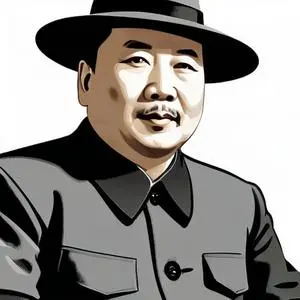
Mao Zedong: The Architect of Modern China
The Revolutionary Leader
Mao Zedong, also known as Chairman Mao, is renowned as the founder of the People's Republic of China (PRC), a Marxist theorist, military strategist, poet, and revolutionary who led the country from its establishment in 1949 until his death in 1976. As the chairman of the Chinese Communist Party (CCP), Mao's theories, military strategies, and policies are collectively known as Maoism, which have had a profound impact on modern China.
Early Life and Influences
Born on December 26, 1893, in Shaoshan, Hunan, China, Mao was the son of a prosperous peasant family. His early life was marked by a strong sense of Chinese nationalism and anti-imperialism, which was fueled by the Xinhai Revolution of 1911 and the May Fourth Movement of 1919. During his time at Peking University, where he worked as a librarian, Mao was introduced to Marxism-Leninism, which would later shape his political ideology.
Rise to Power
Mao's journey to becoming the leader of China was marked by several significant events. In 1927, he led the Autumn Harvest Uprising, and later founded the Chinese Red Army. During the Chinese Civil War, Mao implemented radical land reform policies in the Jiangxi Soviet, which earned him recognition within the CCP. His leadership during the Long March solidified his position as the head of the CCP.
Founding of the People's Republic of China
On October 1, 1949, Mao proclaimed the establishment of the PRC, a Marxist-Leninist single-party state controlled by the CCP. This marked the beginning of a new era in Chinese history, with Mao at the helm.
Consolidation of Power
In the following years, Mao implemented several campaigns to solidify his control, including the land reform campaign against landlords, the Campaign to Suppress Counterrevolutionaries, the Three-anti and Five-anti Campaigns, and a truce in the Korean War. These campaigns resulted in the deaths of several million Chinese.
Economic Reforms
From 1953 to 1958, Mao played a crucial role in enforcing a command economy in China, constructing the first Constitution of the PRC, and launching an industrialization program.
Legacy and Impact
Mao's legacy is complex and multifaceted. While he is credited with modernizing China and ending centuries of imperial rule, his policies also led to widespread poverty, famine, and human rights abuses. Today, Mao remains a divisive figure, revered by some as a national hero and reviled by others as a ruthless dictator.
Quotes and Memorable Sayings
- "A revolution is not a dinner party, or writing an essay, or painting a picture, or doing embroidery; it cannot be so refined, so leisurely and gentle, so temperate, kind, courteous, restrained and magnanimous. A revolution is an insurrection, an act of violence by which one class overthrows another."
- "The people, and the people alone, are the motive force of world history."
Personal Milestones and Key Life Events
- 1893: Born in Shaoshan, Hunan, China
- 1918: Graduated from Hunan First Normal University
- 1921: Co-founded the Chinese Communist Party (CCP)
- 1927: Led the Autumn Harvest Uprising
- 1935: Became the Chairman of the CCP
- 1949: Proclaimed the establishment of the People's Republic of China
- 1976: Died on September 9
Historical Context and Legacy
Mao's life and legacy must be understood within the context of China's tumultuous 20th century. His policies and theories continue to shape modern China, and his impact on world history is undeniable. Love him or hate him, Mao Zedong remains one of the most influential figures of the 20th century.
FAQ
What was Mao Zedongs role in the Chinese Communist Party?
Mao Zedong was the chairman of the Chinese Communist Party and a founding father of the Peoples Republic of China. He played a central role in the countrys revolution and subsequent economic development.
What were Mao Zedongs key policies?
Mao Zedongs key policies included the Great Leap Forward, the Cultural Revolution, and the Five-Year Plans. These policies had a profound impact on Chinas economy, society, and politics.
How did Mao Zedong consolidate power?
Mao Zedong consolidated power through a combination of political maneuvering, propaganda, and coercion. He eliminated opposition, purged rivals, and created a cult of personality that elevated him to a position of supreme authority.
What was Mao Zedongs relationship with the Soviet Union?
Mao Zedongs relationship with the Soviet Union was complex and often tense. While China initially received significant support from the Soviet Union, Mao later criticized Soviet policies and pursued a more independent path.
What is Mao Zedongs legacy in modern China?
Mao Zedongs legacy in modern China is complex and contested. While some view him as a national hero who unified China and promoted economic development, others criticize his policies as brutal and repressive.