


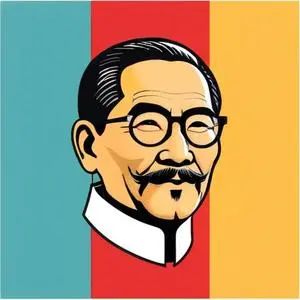
A Chinese revolutionary who led the overthrow of the Qing dynasty and founded the Republic of China, known for his role in shaping modern China's government and politics.
Sun Yatsen, also known as Sun Zhongshan, is revered as the Father of the Nation in Taiwan and the Forerunner of the Revolution in mainland China. He is renowned for his pivotal role in overthrowing the Qing dynasty during the 1911 Revolution, marking the end of imperial China and paving the way for the establishment of the Republic of China.
Sun Yatsen was a visionary leader, statesman, and political philosopher who devoted his life to creating a modern, democratic China. He is celebrated for his instrumental role in shaping the country's political landscape, and his legacy continues to inspire generations of Chinese people.
Sun Yatsen's most enduring contribution to modern China is his political philosophy, known as the Three Principles of the People. These principles – nationalism, democracy, and people's livelihood – remain the core ideology of the Kuomintang (Nationalist Party) and continue to influence Chinese politics to this day.
Sun Yatsen's political life was marked by constant struggle and frequent exile. In 1895, he was exiled to Japan after a failed uprising against the Qing dynasty. He spent several years in exile, during which time he refined his political philosophy and built alliances with overseas Chinese communities.
In 1911, Sun Yatsen returned to China and was elected as the provisional president of the Republic of China. However, he soon resigned and relinquished the position to Yuan Shikai, a former Qing general, in an effort to promote national unity.
In 1923, Sun Yatsen invited representatives of the Communist International to Canton (now Guangzhou) to reorganize his party and form a united front with the Chinese Communist Party. This alliance, though brittle, marked a significant shift in Sun's approach to achieving his political goals.
Sun Yatsen's legacy extends far beyond his own lifetime. He is revered as a national hero in both Taiwan and mainland China, and his political philosophy continues to shape Chinese politics and society. His commitment to democracy, social justice, and national unity remains an inspiration to generations of Chinese people.
Although Sun Yatsen did not live to see the unification of China under his successor, Chiang Kaishek, his vision of a modern, democratic China continues to influence the country's development.
Sun Yatsen's remarkable life and legacy are a testament to his unwavering dedication to creating a better future for the Chinese people. As we reflect on his life and achievements, we are reminded of the power of vision, perseverance, and leadership in shaping the course of history.
Born in 1887
Led the Nationalist Party in China, fighting against the Communist Party and later establishing the government of Taiwan. He's known for his role in shaping modern Chinese history.
Born in 1882
A key figure in the Xinhai Revolution, he founded the Nationalist Party and played a crucial role in ending imperial rule in China. He's remembered for his efforts to establish a democratic republic.
Born in 1874
A key figure in the Xinhai Revolution, leading the Wuchang Uprising and serving as the first Minister of War in the Republic of China. He played a crucial role in ending imperial rule and establishing a republic in China.
Born in 1858
A Chinese scholar and politician who advocated for constitutional monarchy and social reform in late Qing dynasty China, and is known for his influential writings on modernizing Chinese society.
