


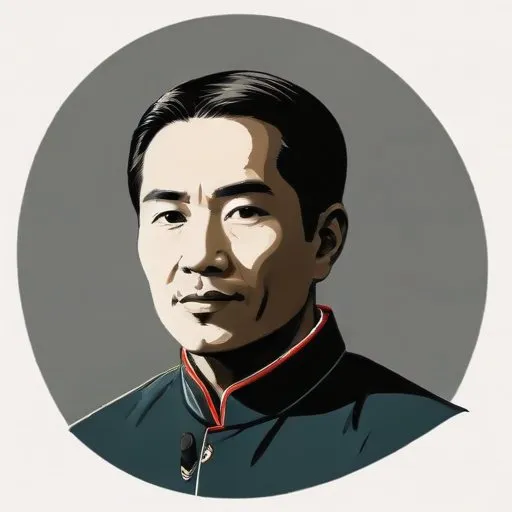
A key figure in the Xinhai Revolution, he founded the Nationalist Party and played a crucial role in ending imperial rule in China. He's remembered for his efforts to establish a democratic republic.
Song Jiaoren was a Chinese republican revolutionary, political leader, and founder of the Kuomintang (KMT), who led the party to electoral victories in China's first democratic election. He is remembered for his efforts to bring about democratic reforms and modernize China's political landscape.
Song Jiaoren was born on April 5, 1882, in Hunan, China. He began his education at a private school at the age of six and later enrolled at Taoyuan Zhangjiang College. Under the influence of his teachers, Huang Shouyi and Qu Fangmei, Song developed an interest in world events and the counterculture, rather than pursuing the traditional path of civil service examinations.
In 1902, Song attended the Bishop Boone Memorial School (now Central China Normal University) in Wuchang, where he met Huang Xing, a fellow revolutionary and lifelong friend. After Huang's departure, Song continued to organize revolutionary groups in Hunan, focusing on Changsha and Changde. He later taught at the Wuchang Normal School, becoming involved with local revolutionary groups, including the Huaxinghui, where he served as vice president.
Song Jiaoren's leadership skills and vision for a democratic China propelled him to the forefront of the KMT. He founded the party's Hunan branch and played a crucial role in its early development. In 1912, Song led the KMT to a landslide victory in China's first democratic election, earning him recognition as a pioneering figure in Chinese politics.
Song Jiaoren's life was tragically cut short on March 20, 1913, when he was assassinated, allegedly on the orders of provisional president Yuan Shikai. His death sent shockwaves throughout China, and his legacy as a champion of democracy and reform continues to inspire generations.
Song Jiaoren believed in the power of education and democracy to transform China's social and political landscape. He advocated for a constitutional government, an end to imperial rule, and the empowerment of the Chinese people. His philosophical contributions have had a lasting impact on Chinese politics and continue to influence contemporary thought.
Song Jiaoren's vision for a democratic China has had a profound impact on modern Chinese society. His legacy has inspired generations of Chinese leaders, reformers, and activists, shaping the country's political trajectory. His commitment to democracy and human rights remains a beacon of hope for a more just and equitable society.
Song Jiaoren's life and work are a testament to the tumultuous era in which he lived. His legacy serves as a reminder of the struggles faced by Chinese reformers and revolutionaries in the early 20th century. Today, he is revered as a national hero, and his contributions continue to shape China's political and social landscape.
Song Jiaoren's words continue to inspire and motivate, serving as a reminder of his unwavering commitment to democracy and reform.
Song Jiaoren's life was marked by significant milestones and events that shaped his vision for a modern, democratic China.
Born in 1866
A Chinese revolutionary who led the overthrow of the Qing dynasty and founded the Republic of China, known for his role in shaping modern China's government and politics.
Born in 1874
A key figure in the Xinhai Revolution, leading the Wuchang Uprising and serving as the first Minister of War in the Republic of China. He played a crucial role in ending imperial rule and establishing a republic in China.
