


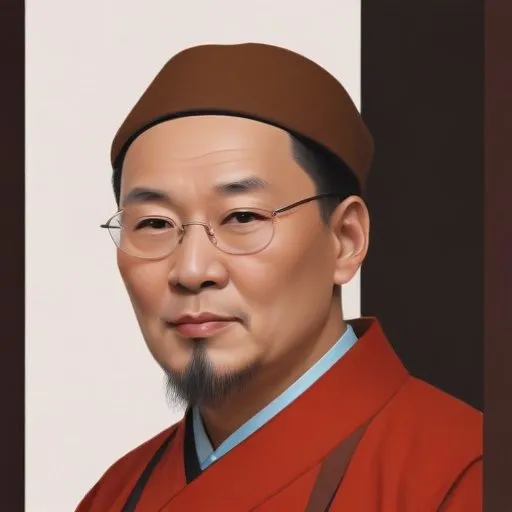
A Chinese scholar and politician who advocated for constitutional monarchy and social reform in late Qing dynasty China, and is known for his influential writings on modernizing Chinese society.
Kang Youwei, a prominent Chinese political thinker and reformer, is renowned for his influential ideas that shaped the late Qing dynasty and the Republic of China. His advocacy for a constitutional monarchy, which sparked conflict between the Guangxu Emperor and Empress Dowager Cixi, left an indelible mark on Chinese history.
Kang was born on March 19, 1858, in Su Village, Nanhai County, Guangdong province. Recognized for his intellectual gifts at a young age, he was sent to study the Confucian classics to pass the Chinese civil service exams. However, as a teenager, he grew dissatisfied with the scholastic system, which he believed emphasized artificial literary exercises over meaningful learning.
In pursuit of a more profound understanding, Kang engaged in Buddhist meditation as a form of relaxation, an unusual leisurely activity for a Chinese scholar of his time. It was during one of these meditations that he had a mystical vision, which became the theme for his intellectual pursuits throughout his life. Believing that it was possible to read every book and become a sage, he embarked on a quasimessianic pursuit to save humanity.
In his seminal work, A Study of Confucius as a Reformer of Institutions, Kang called for an end to property and the family in the interest of an idealized future cosmopolitan utopia. He cited Confucius as an example of a reformer, rather than a reactionary, as many of his contemporaries did. This work showcased Kang's ability to reinterpret traditional Confucian values in the context of modernization and reform.
Kang's increasing closeness to and influence over the young Guangxu Emperor sparked conflict between the emperor and his adoptive mother, the regent Empress Dowager Cixi. In 1898, Kang's ideas were instrumental in the abortive Hundred Days Reform, a series of radical reforms aimed at modernizing China. However, the reform was ultimately thwarted by Cixi, and Kang was forced to flee for his life.
Kang continued to advocate for a constitutional monarchy after the founding of the Republic of China. His ideas influenced generations of Chinese intellectuals and politicians, shaping the country's trajectory towards modernization. Today, Kang is remembered as a visionary who dared to challenge traditional values and push for radical reforms.
Kang Youwei's remarkable life and intellectual pursuits continue to inspire generations of scholars, politicians, and reformers. His legacy serves as a testament to the power of visionary thinking and the importance of advocating for positive change.
Born in 1811
A prominent Qing dynasty military leader and statesman who played a crucial role in suppressing the Taiping Rebellion and modernizing China's military and economy. He's also known for his literary and philosophical works.
Born in 1859
A Chinese general and politician who rose to become the first president of the Republic of China, known for his role in ending the Qing dynasty and establishing a new government. He's also infamous for his attempts to restore the monarchy with himself as emperor.
Born in 1835
The last empress of China, who ruled with an iron fist and brought about significant modernization reforms, while also being known for her extravagant lifestyle and corruption.
Born in 1866
A Chinese revolutionary who led the overthrow of the Qing dynasty and founded the Republic of China, known for his role in shaping modern China's government and politics.
Born in 1887
Led the Nationalist Party in China, fighting against the Communist Party and later establishing the government of Taiwan. He's known for his role in shaping modern Chinese history.
Born in 1893
Leader of the Chinese Communist Party who implemented radical social and economic reforms, including the Great Leap Forward and the Cultural Revolution, shaping modern China's politics and economy.
