


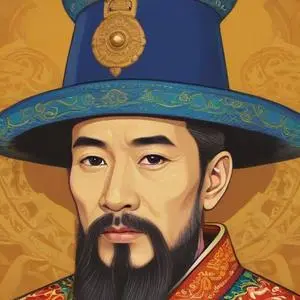
The last emperor of the Qing dynasty, ruling China from 1875 to 1908, known for his attempts to modernize and reform the country, but ultimately failing to prevent its downfall.
The Guangxu Emperor, also known as Emperor Dezong of Qing, was the tenth emperor of the Qing dynasty and the ninth Qing emperor to rule over China proper. He is remembered for his radical Hundred Days Reform, a brief but ambitious attempt to modernize and democratize China, which was abruptly halted by his aunt, Empress Dowager Cixi, in 1898.
Born on August 14, 1871, the Guangxu Emperor was the second son of Prince Chun, Yixuan, a son of the Daoguang Emperor, and his mother, Yehenara Wanzhen, the sister of Empress Dowager Cixi. Following the death of Emperor Tongzhi in 1874, he was supported by the two Empress Dowagers, Cian and Cixi, to succeed the throne, being adopted at the age of three by Emperor Xianfeng and the two Empress Dowagers.
During the early years of his reign, the two dowagers jointly handled state affairs. After Empress Dowager Cian's death in 1881, Cixi continued to act as the sole regent. In 1889, Guangxu got married and announced his personal rule, marking the beginning of his efforts to modernize and reform China. His radical Hundred Days Reform, launched in 1898, aimed to transform China into a constitutional monarchy, introduce democratic reforms, and promote education and industry. However, the reform was short-lived, and Empress Dowager Cixi launched a coup, stripping Guangxu of his powers and confining him to the Yingtai Pavilion of Zhongnanhai.
The Guangxu Emperor's life was marked by turbulence and hardship. He was forced to leave his home and enter the palace at a young age, where he was strictly controlled and disciplined by Cixi. He died on November 14, 1908, at the age of 38, allegedly due to arsenic poisoning, without leaving any descendants. He was buried in the Chongling Mausoleum of the Western Qing Tombs.
The Guangxu Emperor's reign was marked by his failed attempts to reform and modernize China, but his efforts had a lasting impact on the country's trajectory. His Hundred Days Reform set the stage for future reform movements and paved the way for the eventual fall of the Qing dynasty. Despite his turbulent reign, the Guangxu Emperor remains an important figure in Chinese history, serving as a symbol of the country's struggle for modernization and democracy.
The Guangxu Emperor's reign can be compared to that of his contemporaries, such as the Meiji Emperor of Japan, who successfully modernized and transformed Japan into a constitutional monarchy. While the Guangxu Emperor's efforts were ultimately unsuccessful, they demonstrate the complexities and challenges faced by Chinese leaders during a period of rapid change and modernization.
Born in 1835
The last empress of China, who ruled with an iron fist and brought about significant modernization reforms, while also being known for her extravagant lifestyle and corruption.
Born in 1859
A Chinese general and politician who rose to become the first president of the Republic of China, known for his role in ending the Qing dynasty and establishing a new government. He's also infamous for his attempts to restore the monarchy with himself as emperor.
Born in 1858
A Chinese scholar and politician who advocated for constitutional monarchy and social reform in late Qing dynasty China, and is known for his influential writings on modernizing Chinese society.
Born in 1873
A pioneering Chinese intellectual who advocated for democracy, individual rights, and social reform through his influential writings and teachings. He's credited with introducing Western philosophical ideas to China, shaping the country's modernization efforts.
