


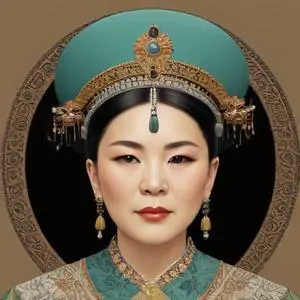
The last empress of China, who ruled with an iron fist and brought about significant modernization reforms, while also being known for her extravagant lifestyle and corruption.
Empress Dowager Cixi, a name synonymous with power, politics, and intrigue, dominated the Qing dynasty for nearly five decades, leaving an indelible mark on Chinese history. As the de facto ruler of China from 1861 to 1908, she was the last empress dowager to wield significant influence, shaping the country's destiny with her cunning, wit, and foresight.
Born on November 29, 1835, Cixi was a member of the Yehe Nara clan, a noble Manchu family. Selected as a concubine of the Xianfeng Emperor in her adolescence, she quickly rose to prominence, giving birth to a son, Zaichun, in 1856. Following the Xianfeng Emperor's death in 1861, her five-year-old son became the Tongzhi Emperor, and Cixi assumed the role of co-empress dowager alongside Xianfeng's widow, Empress Dowager Cian.
Cixi's astute political maneuvering led to the ousting of the regents appointed by the late emperor, paving the way for her to assume the regency alongside Cian. Upon the death of the Tongzhi Emperor in 1875, Cixi installed her nephew as the Guangxu Emperor, solidifying her grip on the dynasty. With Cian's passing in 1881, Cixi emerged as the sole empress dowager, her influence uncontested.
Cixi oversaw the Tongzhi Restoration, a series of moderate reforms aimed at modernizing China. While she refused to adopt Western models of government, she supported technological, military, and economic reforms, as well as the Self-Strengthening Movement. Her caution regarding the radical reforms of 1898, however, led to the execution of reformers and the Guangxu Emperor's virtual house arrest.
The Boxer Rebellion, a devastating sequence of events, saw Cixi initially backing the Boxer groups and declaring war on foreign invaders. The subsequent defeat and occupation of Beijing led to a humiliating reversal, with Cixi ultimately seeking rapprochement with foreigners and implementing fiscal and institutional reforms aimed at transforming China into a constitutional monarchy.
Cixi's personal life was marked by intrigue, gossip, and speculation. Her relationships with eunuchs, advisors, and even the Guangxu Emperor have been the subject of much debate and myth-making. Despite her controversial reputation, Empress Dowager Cixi remains an enigmatic figure, acknowledged as one of the most influential women in Chinese history.
Cixi's reign occurred during a period of great turmoil and transformation, with China facing internal strife, foreign encroachment, and the decline of the Qing dynasty. Her legacy, though complex and multifaceted, is a testament to her remarkable tenacity, intelligence, and strategic thinking. As China navigates its modern trajectory, the story of Empress Dowager Cixi serves as a poignant reminder of the country's rich history and its ongoing quest for identity and greatness.
Empress Dowager Cixi's life and legacy continue to captivate historians, scholars, and enthusiasts alike, her complex, multifaceted persona an enduring testament to the power and intrigue of the Qing dynasty.
Born in 1811
A prominent Qing dynasty military leader and statesman who played a crucial role in suppressing the Taiping Rebellion and modernizing China's military and economy. He's also known for his literary and philosophical works.
Born in 1858
A Chinese scholar and politician who advocated for constitutional monarchy and social reform in late Qing dynasty China, and is known for his influential writings on modernizing Chinese society.
