


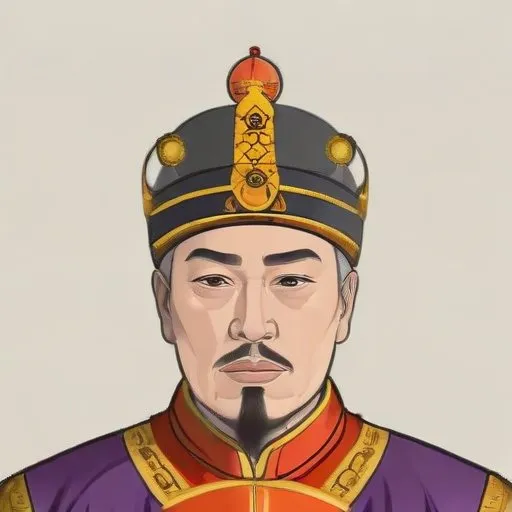
The ninth emperor of the Qing dynasty, ruling from 1850 to 1861, is known for his attempts to reform the government and military, but ultimately failing to prevent the decline of the dynasty. He is also infamous for his opium addiction and seclusion from state affairs.
The Xianfeng Emperor, also known as Emperor Wenzong of Qing, is infamous for presiding over one of the most tumultuous periods in Qing dynasty history, marked by devastating wars, rebellions, and foreign invasions that threatened the very existence of the empire.
Born on July 17, 1831, the Xianfeng Emperor ascended to the throne in 1850, inheriting an empire in disarray, and would go on to face some of the greatest challenges of his dynasty's history.
The Xianfeng Emperor's reign was marked by a series of devastating conflicts, including the Taiping Rebellion, the Nian Rebellion, and the Second Opium War, which would ultimately lead to the cession of Manchuria to the Russian Empire.
These conflicts would eventually lead to the Qing dynasty's defeat during the First Opium War and the signing of the Treaty of Tientsin and the Treaty of Aigun, marking a significant shift in the balance of power in favor of foreign powers.
Despite the turmoil surrounding his reign, the Xianfeng Emperor was known for his intellectual pursuits, particularly in the fields of literature and poetry. He was also a patron of the arts, commissioning numerous works of art and architecture during his reign.
The Xianfeng Emperor's personal life was marked by tragedy, including the death of his empress, Empress Xiaojingcheng, in 1852. He would go on to marry Empress Dowager Cixi, who would play a significant role in his later life and ultimately rise to power after his death.
The Xianfeng Emperor died on August 22, 1861, at the age of 30, in Jehol, where he had fled to escape the Anglo-French forces that had occupied Beijing. He was succeeded by his six-year-old son, who would go on to become the Tongzhi Emperor.
Despite his tumultuous reign, the Xianfeng Emperor's legacy is marked by his efforts to modernize and reform the Qing dynasty, including the establishment of the Tongwen Guan, a school for the study of foreign languages and cultures.
His reign also saw the rise of influential figures, including Empress Dowager Cixi, who would go on to play a significant role in shaping the future of the Qing dynasty.
The Xianfeng Emperor's story serves as a testament to the challenges faced by leaders in times of crisis and the importance of adaptability and innovation in the face of adversity.
Through his tumultuous reign, the Xianfeng Emperor left an indelible mark on Chinese history, shaping the course of the Qing dynasty and paving the way for the modernization of China.
Born in 1782
Ruling China from 1820 to 1850, this emperor oversaw a period of decline, marked by the Opium Wars and the cession of Hong Kong to Britain. He's also known for his efforts to reform the government and economy.
Born in 1871
The last emperor of the Qing dynasty, ruling China from 1875 to 1908, known for his attempts to modernize and reform the country, but ultimately failing to prevent its downfall.
Born in 1835
The last empress of China, who ruled with an iron fist and brought about significant modernization reforms, while also being known for her extravagant lifestyle and corruption.
Born in 1811
A prominent Qing dynasty military leader and statesman who played a crucial role in suppressing the Taiping Rebellion and modernizing China's military and economy. He's also known for his literary and philosophical works.
