


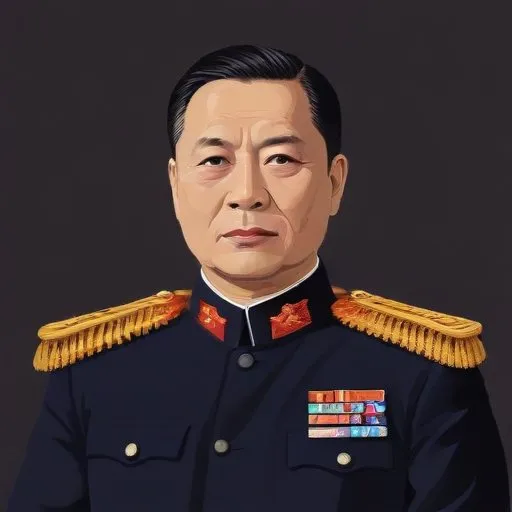
A prominent Chinese military leader and politician who played a crucial role in the Chinese Civil War and the establishment of the People's Republic of China, serving as the second-in-command to Mao Zedong. He's most known for his military strategies and leadership during the war.
Zhu De, a name etched in the annals of Chinese history, is renowned as a brilliant general, military strategist, politician, and revolutionary. He is one of the principal founders of the People's Republic of China, playing a pivotal role in shaping the country's destiny in the 20th century.
Zhu De was born on December 1, 1886, in a poor tenant farmer's family in Sichuan, China. Born into poverty, his family relocated to Sichuan during the migration from Hunan and Guangdong provinces. His early education was facilitated by his uncle's influence, which enabled him to attend a regional private school and later, the Yunnan Military Academy.
Zhu De's military prowess was evident early on, and he soon became a warlord, followed by a stint in the Chinese Communist Party (CCP). During the Second Sino-Japanese War and the Chinese Civil War, he commanded the Eighth Route Army, earning widespread recognition for his strategic brilliance.
By the end of the Chinese Civil War, Zhu De had become a high-ranking party official and a prominent figure in the newly founded People's Republic of China. In 1955, he was ranked first among the ten marshals, solidifying his position as a national hero and a symbol of the country's revolutions.
Zhu De's philosophy was deeply rooted in Marxist-Leninist ideology, which guided his vision for a socialist China. He believed in the importance of rural mobilization and peasant engagement in the revolutionary process, an approach that resonated with Mao Zedong's own views.
Zhu De's life and legacy are deeply entwined with the tumultuous history of 20th-century China. His leadership and vision played a significant role in shaping the country's destiny, earning him a permanent place in the pantheon of Chinese revolutionary heroes.
"The Communist Party is the vehicle for the Chinese people to achieve independence and liberation."
Zhu De's vision for a socialist China continues to inspire generations of Chinese citizens. His commitment to rural development and peasant empowerment has left an enduring legacy in the country's economic and social policies.
Zhu De's life is a testament to the power of revolutionary spirit and vision. As a general, politician, and philosopher, he leaves behind a rich legacy that continues to shape the course of Chinese history.
Born in 1893
Leader of the Chinese Communist Party who implemented radical social and economic reforms, including the Great Leap Forward and the Cultural Revolution, shaping modern China's politics and economy.
Born in 1898
The first Premier of the People's Republic of China, serving from 1949 until his death in 1976, is most known for his key role in the Chinese Communist Party and his diplomatic efforts to improve relations with the West. He played a crucial part in shaping China's foreign policy and economy during a pivotal period in the country's history.
Born in 1904
A Chinese revolutionary and statesman who led the country's economic reforms, transforming it into a global superpower. He's credited with opening up China to the world and introducing capitalist principles.
73 Years Old
A renowned Chinese violinist and composer, blending Eastern and Western musical styles, creating a unique sound that showcases cultural fusion.
Born in 1898
A prominent military leader who played a crucial role in the Chinese Civil War and later became a key figure in the Communist Party, known for his criticisms of Mao's policies. He was eventually purged and persecuted during the Cultural Revolution.
Born in 1907
A powerful Chinese military leader and politician who rose to prominence during the Chinese Civil War and later became a close ally of Mao Zedong, playing a crucial role in the Cultural Revolution. He is infamous for his alleged plot to overthrow Mao and his mysterious death in a plane crash.
Born in 1896
A prominent Chinese military leader and politician who played a key role in the Chinese Civil War and later served as the 1st Vice Premier of the People's Republic of China, known for his efforts in modernizing the Chinese military. He was a close ally of Mao Zedong and helped establish the People's Liberation Army.
