


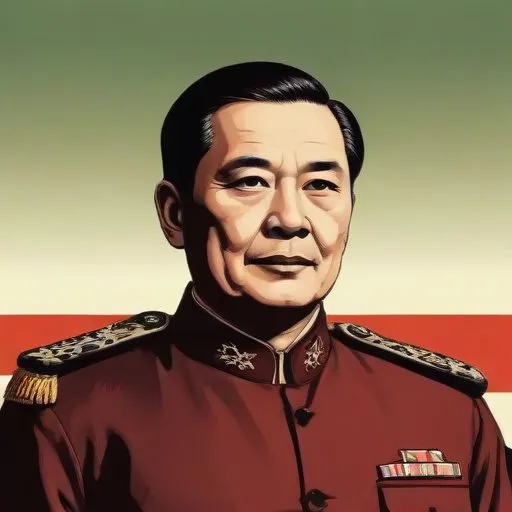
A prominent Chinese military leader and politician who played a key role in the Chinese Civil War and later served as the 1st Vice Premier of the People's Republic of China, known for his efforts in modernizing the Chinese military. He was a close ally of Mao Zedong and helped establish the People's Liberation Army.
He Long, a renowned Chinese Communist revolutionary and one of the Ten Marshals of the People's Republic of China, is best known for his instrumental role in the Chinese Civil War and the Second Sino-Japanese War. His military prowess and strategic leadership played a crucial part in expanding areas of Communist control in Northwest China, earning him a revered place in Chinese history.
He Long was born on March 22, 1896, in a poor rural family in Hunan Province. With no formal education, he began his revolutionary career after avenging the death of his uncle, eventually fleeing to become an outlaw and attracting a small personal army. This unconventional start paved the way for his eventual involvement in the Chinese Revolution.
In 1927, He Long participated in the Nanchang Uprising, a failed attempt to overthrow the Kuomintang (KMT) government. Following the uprising, he organized a soviet in rural Hunan, but was forced to abandon it due to the KMT's Encirclement Campaigns. He joined the Long March in 1935, where he met forces led by Zhang Guotao, with whom he disagreed on the strategy of the Red Army. He eventually led his forces to join and support Mao Zedong, ultimately playing a key role in the Communist victory.
After settling in Shaanxi, He Long led guerrilla forces in Northwest China, achieving significant success in expanding areas of Communist control during the Chinese Civil War and the Second Sino-Japanese War. By the end of 1945, he commanded a force of 170,000 troops, which was then placed under the command of Peng Dehuai, with He serving as his second-in-command.
He Long's military prowess and strategic leadership played a crucial role in the Communist victory in China. His contributions to the revolution and his subsequent service as a high-ranking official in the People's Republic of China have cemented his place as one of the most important figures in modern Chinese history.
Today, He Long's legacy continues to inspire generations of Chinese people, and his name is synonymous with bravery, strategic thinking, and devotion to the Communist cause.
As one of the most revered figures in Chinese history, He Long's life serves as a testament to the power of determination and perseverance in the face of adversity.
Born in 1893
Leader of the Chinese Communist Party who implemented radical social and economic reforms, including the Great Leap Forward and the Cultural Revolution, shaping modern China's politics and economy.
Born in 1898
The first Premier of the People's Republic of China, serving from 1949 until his death in 1976, is most known for his key role in the Chinese Communist Party and his diplomatic efforts to improve relations with the West. He played a crucial part in shaping China's foreign policy and economy during a pivotal period in the country's history.
Born in 1904
A Chinese revolutionary and statesman who led the country's economic reforms, transforming it into a global superpower. He's credited with opening up China to the world and introducing capitalist principles.
Born in 1898
A prominent military leader who played a crucial role in the Chinese Civil War and later became a key figure in the Communist Party, known for his criticisms of Mao's policies. He was eventually purged and persecuted during the Cultural Revolution.
Born in 1907
A powerful Chinese military leader and politician who rose to prominence during the Chinese Civil War and later became a close ally of Mao Zedong, playing a crucial role in the Cultural Revolution. He is infamous for his alleged plot to overthrow Mao and his mysterious death in a plane crash.
73 Years Old
A renowned Chinese violinist and composer, blending Eastern and Western musical styles, creating a unique sound that showcases cultural fusion.
