


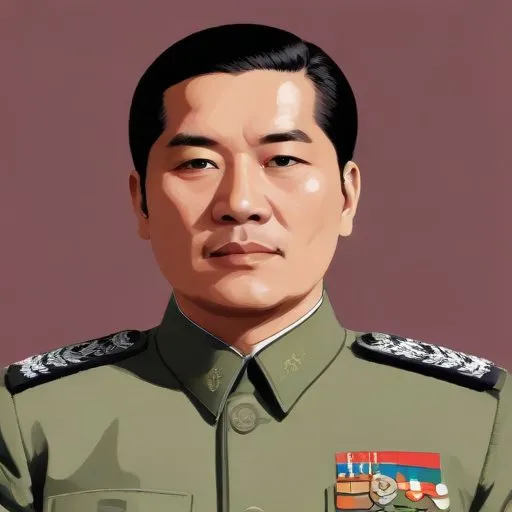
A powerful Chinese military leader and politician who rose to prominence during the Chinese Civil War and later became a close ally of Mao Zedong, playing a crucial role in the Cultural Revolution. He is infamous for his alleged plot to overthrow Mao and his mysterious death in a plane crash.
Lin Biao, a renowned Chinese politician and Marshal of the People's Republic of China, is famously known for his instrumental role in the Communist victory during the Chinese Civil War, particularly in Northeast China from 1946 to 1949. As a brilliant military strategist, he commanded the decisive Liaoshen and Pingjin campaigns, leading the People's Liberation Army into Beijing and cementing his status as a national hero.
Lin's remarkable military prowess propelled him to the forefront of Chinese politics. He ranked third among the Ten Marshals, with only Zhu De and Peng Dehuai considered senior to him. In 1954, he became one of the coserving Vice Premiers of the People's Republic of China, a position he held until 1964, when he was promoted to First Vice Premier.
Lin's most significant contribution to Chinese politics was his role in creating the foundations for Mao Zedong's cult of personality in the early 1960s. Through his zealous support and propaganda efforts, Lin helped elevate Mao to an almost divine status, solidifying his grip on power. As a reward for his services, Lin was named Mao's designated successor as the sole Vice Chairman of the Chinese Communist Party in 1966.
Lin's later years were shrouded in controversy. In 1971, he died in a plane crash in Mongolia, with the Chinese government claiming he was attempting to flee following a botched coup against Mao. However, many speculate about the true circumstances surrounding his death.
Lin Biao's legacy is complex and multifaceted. While he played a crucial role in shaping modern Chinese history, his complicity in Mao's cult of personality and his mysterious death have left many questions unanswered. Nevertheless, his remarkable military achievements and political prowess continue to fascinate historians and scholars alike.
"The people's army is the instrument of the people's revolution."
Lin Biao's life and legacy serve as a testament to the intricacies of power, politics, and personality in modern Chinese history. While his story is marked by both triumph and tragedy, his impact on the course of Chinese politics remains undeniable.
Born in 1893
Leader of the Chinese Communist Party who implemented radical social and economic reforms, including the Great Leap Forward and the Cultural Revolution, shaping modern China's politics and economy.
Born in 1898
The first Premier of the People's Republic of China, serving from 1949 until his death in 1976, is most known for his key role in the Chinese Communist Party and his diplomatic efforts to improve relations with the West. He played a crucial part in shaping China's foreign policy and economy during a pivotal period in the country's history.
Born in 1898
A prominent military leader who played a crucial role in the Chinese Civil War and later became a key figure in the Communist Party, known for his criticisms of Mao's policies. He was eventually purged and persecuted during the Cultural Revolution.
Born in 1904
A Chinese revolutionary and statesman who led the country's economic reforms, transforming it into a global superpower. He's credited with opening up China to the world and introducing capitalist principles.
Born in 1886
A prominent Chinese military leader and politician who played a crucial role in the Chinese Civil War and the establishment of the People's Republic of China, serving as the second-in-command to Mao Zedong. He's most known for his military strategies and leadership during the war.
73 Years Old
A renowned Chinese violinist and composer, blending Eastern and Western musical styles, creating a unique sound that showcases cultural fusion.
Born in 1896
A prominent Chinese military leader and politician who played a key role in the Chinese Civil War and later served as the 1st Vice Premier of the People's Republic of China, known for his efforts in modernizing the Chinese military. He was a close ally of Mao Zedong and helped establish the People's Liberation Army.
