


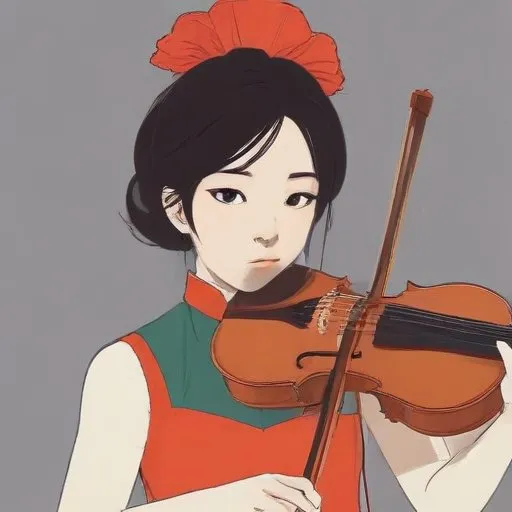
A renowned Chinese violinist and composer, blending Eastern and Western musical styles, creating a unique sound that showcases cultural fusion.
Renowned for her groundbreaking contributions to contemporary classical music, Chen Yi is a trailblazing Chinese-American composer and violinist, celebrated for her innovative fusion of Eastern and Western musical traditions. As the first Chinese woman to receive a Master of Arts in music composition from the Central Conservatory of Music in Beijing, Chen Yi's oeuvre is a testament to her unwavering passion and dedication to the art of music.
Born on April 4, 1953, Chen Yi's love affair with music began at the tender age of three, when she started learning classical music alongside her siblings. Her parents, ardent music lovers, encouraged her to explore the world of piano and violin, laying the foundation for her future success. Chen Yi's prodigious talent was evident even in her early years, as she effortlessly memorized the works of Mozart, Bach, Beethoven, and Tchaikovsky, singing their compositions note for note.
The tumultuous years of the Cultural Revolution had a profound impact on Chen Yi's life and artistic development. Along with her siblings, she was sent to a rural work camp, where she was forced to abandon her classical music roots and focus solely on revolutionary songs. This period of turmoil, however, did not extinguish her passion for music. Instead, it kindled a fire within her, driving her to become the concertmaster of the Peking Opera in Beijing at the remarkable age of 17.
Chen Yi's academic journey was marked by numerous milestones, including her admission to the prestigious Central Conservatory of Music in 1978, where she earned her bachelor's and master's degrees. Her research on Chinese folk music during summer breaks played a significant role in shaping her unique compositional style. In 1998, she earned a Doctor of Musical Arts degree with distinction from Columbia University, studying under the guidance of renowned composers Wu Zuqiang, Chou Wenchung, and Mario Davidovsky.
Chen Yi's compositions are a reflection of her eclectic influences, blending elements of Chinese folk music, classical music, and modern experimental techniques. Her works have been recognized with numerous awards, including the Koussevitzky Music Foundation Award, the American Academy of Arts and Letters' Lieberson Award, and fellowships from the Guggenheim Foundation and the National Endowment for the Arts.
Chen Yi's remarkable career has paved the way for future generations of composers, inspiring a new wave of musicians to explore the intersection of Eastern and Western musical traditions. Her compositions continue to captivate audiences worldwide, breaking down cultural barriers and fostering a deeper understanding between nations.
Through her music, Chen Yi has created a lasting legacy, one that not only celebrates her remarkable talent but also serves as a testament to the transformative power of art.
Born in 1893
Leader of the Chinese Communist Party who implemented radical social and economic reforms, including the Great Leap Forward and the Cultural Revolution, shaping modern China's politics and economy.
Born in 1898
The first Premier of the People's Republic of China, serving from 1949 until his death in 1976, is most known for his key role in the Chinese Communist Party and his diplomatic efforts to improve relations with the West. He played a crucial part in shaping China's foreign policy and economy during a pivotal period in the country's history.
Born in 1904
A Chinese revolutionary and statesman who led the country's economic reforms, transforming it into a global superpower. He's credited with opening up China to the world and introducing capitalist principles.
Born in 1926
Former Chinese leader who ruled the country from 1989 to 2004, known for his economic reforms and authoritarian grip on power. He's also famous for his "Three Represents" theory, which aimed to broaden the Communist Party's appeal.
83 Years Old
The 5th Paramount leader of China, who served from 2002 to 2012, is known for his role in China's rapid economic growth and his "Scientific Development Concept" policy. He also increased China's global influence through strategic diplomacy.
Born in 1907
A powerful Chinese military leader and politician who rose to prominence during the Chinese Civil War and later became a close ally of Mao Zedong, playing a crucial role in the Cultural Revolution. He is infamous for his alleged plot to overthrow Mao and his mysterious death in a plane crash.
Born in 1886
A prominent Chinese military leader and politician who played a crucial role in the Chinese Civil War and the establishment of the People's Republic of China, serving as the second-in-command to Mao Zedong. He's most known for his military strategies and leadership during the war.
