


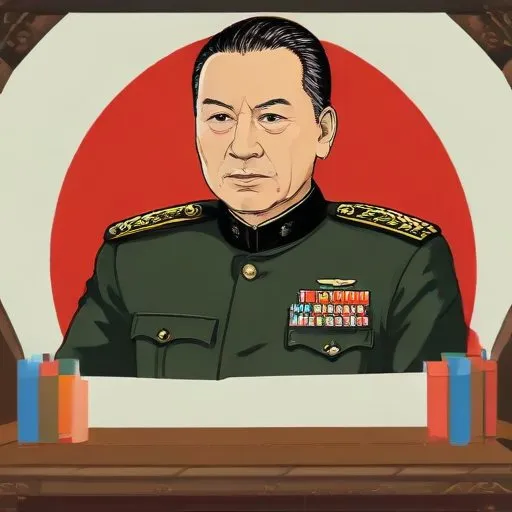
A prominent military leader who played a crucial role in the Chinese Civil War and later became a key figure in the Communist Party, known for his criticisms of Mao's policies. He was eventually purged and persecuted during the Cultural Revolution.
Peng Dehuai, a renowned Chinese general, is best known for his instrumental role in China's defense as the Minister of National Defense from 1954 to 1959. He was a highly respected military leader who played a crucial part in the country's fight against the Japanese occupation and later became a prominent figure in the Chinese Communist Party.
Born on October 24, 1898, in a poor peasant family, Peng Dehuai's early life was marked by poverty and hardship. He received only a few years of primary education before being forced to work as a manual laborer at the tender age of ten. However, this difficult start did not deter him from pursuing a career in the military.
At 16, Peng joined the army and quickly rose through the ranks, becoming a major in just ten years. He served in the armies of several Hunan-based warlord armies before joining the Kuomintang in 1926. It was during this time that Peng was introduced to communism, which would later shape his political beliefs and allegiances.
In 1928, Peng's forces joined the Chinese Communist Party (CCP), and he allied himself with Mao Zedong and Zhu De. He played a vital role in defending the Jiangxi Soviet from Chiang Kai-shek's attempts to capture it, earning recognition as one of the most senior generals in the party.
Peng participated in the Long March, a pivotal event in Chinese history, and supported Mao Zedong at the Zunyi Conference. This conference marked a critical turning point in Mao's rise to power, and Peng's support played a significant role in shaping the party's future.
During the Second Sino-Japanese War (1937-1945), Peng was one of the strongest supporters of pursuing a ceasefire with the Kuomintang to concentrate China's collective resources on resisting the Japanese Empire. He played a crucial role in the combined Kuomintang-Communist efforts to resist the Japanese occupation of Shanxi in 1937 and later commanded two-thirds of the Eighth Route Army.
In 1940, Peng conducted the Hundred Regiments Offensive, a massive Communist effort to disrupt Japanese logistical networks across northern China. Although modestly successful, political disputes within the Communist Party led to Peng being recalled to Yanan, where he spent the rest of the war.
Peng Dehuai's contributions to China's defense and the Communist Party's rise to power are undeniable. Despite facing challenges and controversies throughout his career, Peng remains a highly respected figure in Chinese history. His legacy continues to shape China's military strategy and defense policies to this day.
Peng Dehuai's remarkable career serves as a reminder of the significant role he played in shaping China's defense and the Communist Party's history. His legacy continues to inspire and educate generations of Chinese military leaders and politicians.
Born in 1893
Leader of the Chinese Communist Party who implemented radical social and economic reforms, including the Great Leap Forward and the Cultural Revolution, shaping modern China's politics and economy.
Born in 1898
The first Premier of the People's Republic of China, serving from 1949 until his death in 1976, is most known for his key role in the Chinese Communist Party and his diplomatic efforts to improve relations with the West. He played a crucial part in shaping China's foreign policy and economy during a pivotal period in the country's history.
Born in 1907
A powerful Chinese military leader and politician who rose to prominence during the Chinese Civil War and later became a close ally of Mao Zedong, playing a crucial role in the Cultural Revolution. He is infamous for his alleged plot to overthrow Mao and his mysterious death in a plane crash.
Born in 1896
A prominent Chinese military leader and politician who played a key role in the Chinese Civil War and later served as the 1st Vice Premier of the People's Republic of China, known for his efforts in modernizing the Chinese military. He was a close ally of Mao Zedong and helped establish the People's Liberation Army.
73 Years Old
A renowned Chinese violinist and composer, blending Eastern and Western musical styles, creating a unique sound that showcases cultural fusion.
