


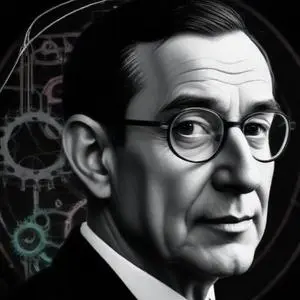
A pioneer in artificial intelligence, decision-making, and problem-solving, he's renowned for his work on bounded rationality and the concept of satisficing.
Herbert A. Simon, a pioneer in the fields of computer science, economics, and cognitive psychology, is renowned for his groundbreaking theories of bounded rationality and satisficing. His work has had a profound impact on our understanding of decision-making within organizations, earning him the Nobel Memorial Prize in Economic Sciences in 1978 and the Turing Award in computer science in 1975.
Schooled in the art of inquiry, Simon's research traversed multiple disciplines, including cognitive science, computer science, public administration, management, and political science. His tenure at Carnegie Mellon University, spanning over five decades, witnessed the founding of the Carnegie Mellon School of Computer Science, one of the world's first such departments.
Born in Milwaukee, Wisconsin, on June 15, 1916, Simon's fascination with science and curiosity about the world around him was evident from an early age. His father, Arthur Simon, an electrical engineer and inventor, instilled in him a strong sense of inquiry and analytical thinking.
Schooled in Milwaukee Public Schools, Simon developed a passion for science and established himself as an atheist. His European ancestors, piano makers, goldsmiths, and vintners, imbued in him a rich cultural heritage.
Simon's work has had a profound impact on modern society, influencing the way we approach decision-making, problem-solving, and information processing. His legacy extends to various fields, including economics, computer science, psychology, and management.
"A wealth of information creates a poverty of attention."
Simon's collaborations with renowned scholars, such as Allen Newell, have led to significant breakthroughs in artificial intelligence and cognitive psychology.
S Simon's commitment to interdisciplinary research has inspired generations of scholars to venture beyond the boundaries of their disciplines, fostering a culture of innovation and curiosity.
92 Years Old
A Nobel Prize-winning economist and psychologist who pioneered the field of behavioral economics, revealing how cognitive biases and heuristics influence human decision-making.
92 Years Old
A renowned economist and philosopher who has made significant contributions to welfare economics, social choice theory, and development economics, and is known for his work on poverty, famine, and human development.
83 Years Old
A Nobel Prize-winning economist and academic who has made significant contributions to the field of economics, particularly in the areas of information economics and globalization.
Born in 1915
A renowned economist and academic who made significant contributions to the field of economics, particularly in the areas of macroeconomics and international trade. He was awarded the Nobel Prize in Economics in 1970.
Born in 1912
A Nobel Prize-winning economist who championed free market capitalism and limited government intervention, known for his advocacy of laissez-faire economics and influential writings on monetary policy.
Born in 1899
Austrian economist and philosopher who championed free market capitalism and limited government intervention, warning of the dangers of socialism and totalitarianism. His work influenced economic policy and shaped modern libertarian thought.
Born in 1883
A pioneering economist who revolutionized modern economic theory with his groundbreaking ideas on government intervention and fiscal policy, shaping global economic policies.
93 Years Old
A pioneering economist who challenged traditional theories by showing how communities can successfully manage shared resources, leading to a Nobel Prize in Economics in 2009.
