


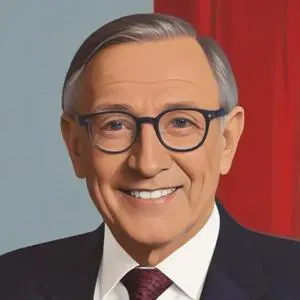
A Nobel Prize-winning economist who made significant contributions to the field of economics, particularly in the areas of microeconomics and industrial organization, and is known for his work on the theory of regulation.
George Stigler, a renowned American economist, is best known for developing the Economic Theory of Regulation, also known as regulatory capture, which posits that interest groups and other political participants shape laws and regulations to benefit themselves. This groundbreaking theory, introduced in 1971, earned him the Nobel Memorial Prize in Economic Sciences in 1982.
Born on January 17, 1911, in Seattle, Washington, Stigler was the son of Elsie Elizabeth Hungler and Joseph Stigler. His mother's Hungarian heritage and his upbringing in a German-speaking household had a profound impact on his life. He graduated from the University of Washington in 1931 with a B.A. and later obtained his MBA from Northwestern University in 1932.
During his studies at Northwestern, Stigler developed a passion for economics, which led him to pursue a PhD in economics at the University of Chicago. Under the guidance of Frank Knight, he earned his PhD in 1938. This marked the beginning of his illustrious academic career, which took him to Iowa State College, Columbia University, Brown University, and eventually back to the University of Chicago, where he spent most of his career.
Stigler's most significant contribution to economics is the Economic Theory of Regulation, which challenges the conventional view that government regulation is designed to protect the public interest. Instead, he argued that regulatory bodies often serve the interests of the industries they are meant to regulate. This theory has far-reaching implications for our understanding of government intervention in the economy.
Stigler's work has had a profound impact on the field of economics, influencing prominent economists like Milton Friedman, W. Allen Wallis, and others. His contributions have shaped the public choice field of economics and continue to influence policy debates to this day. As a testament to his legacy, Stigler is considered a key leader of the Chicago school of economics.
Stigler's numerous accolades include the Nobel Memorial Prize in Economic Sciences (1982), the National Medal of Science (1987), and the Adam Smith Award from the National Association of Business Economists (1981). He was also a fellow of the American Academy of Arts and Sciences and the Econometric Society.
Stigler's life was marked by several significant events, including his work on the Manhattan Project during World War II and his 50-year friendship with Milton Friedman. He passed away on December 1, 1991, leaving behind a legacy that continues to shape the field of economics.
In conclusion, George Stigler's remarkable life and groundbreaking work have left an indelible mark on the field of economics. His Economic Theory of Regulation remains a cornerstone of public choice theory, and his influence will continue to shape economic policy debates for generations to come.
Born in 1912
A Nobel Prize-winning economist who championed free market capitalism and limited government intervention, known for his advocacy of laissez-faire economics and influential writings on monetary policy.
95 Years Old
A pioneer in applying economic theory to social issues, he's most known for his work on human capital, crime and punishment, and the economics of the family.
Born in 1910
A Nobel Prize-winning economist who challenged traditional views on business and government, famously arguing that firms exist to reduce transaction costs and that well-defined property rights can resolve environmental issues.
Born in 1899
Austrian economist and philosopher who championed free market capitalism and limited government intervention, warning of the dangers of socialism and totalitarianism. His work influenced economic policy and shaped modern libertarian thought.
89 Years Old
Developed the theory of rational expectations, which revolutionized macroeconomics by showing how people's expectations of future events affect current economic decisions.
87 Years Old
A Nobel Prize-winning economist and academic who developed the Efficient Market Hypothesis, which revolutionized our understanding of stock markets and investments.
83 Years Old
A Nobel Prize-winning economist and academic who has made significant contributions to the field of economics, particularly in the areas of information economics and globalization.
73 Years Old
A Nobel Prize-winning economist and academic who has made significant contributions to the field of international trade and economic geography, and is also a prominent columnist and author.
