


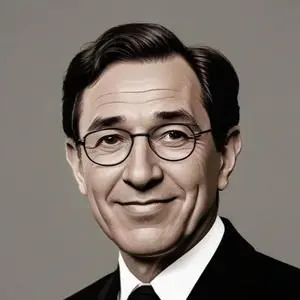
Developed the theory of rational expectations, which revolutionized macroeconomics by showing how people's expectations of future events affect current economic decisions.
Robert Lucas Jr., a Nobel laureate and esteemed economist, is renowned for developing the hypothesis of rational expectations, which revolutionized macroeconomic analysis and deepened our understanding of economic policy. His groundbreaking work transformed the field, earning him the Nobel Memorial Prize in Economic Sciences in 1995.
Lucas was born on September 15, 1937, in Yakima, Washington, as the eldest child of Robert Emerson Lucas and Jane Templeton Lucas. His parents ran an ice creamery in Yakima, but the business failed during the Great Depression, prompting the family to move to Seattle. His mother worked as a fashion designer, and his father worked at a shipbuilding yard and later as a welder with a refrigeration company.
Lucas received his BA in History from the University of Chicago in 1959. He then attended the University of California, Berkeley, as a first-year graduate student but left due to financial reasons and returned to the University of Chicago in 1960. He earned a PhD in Economics in 1964, with a dissertation titled "Substitution Between Labor and Capital in U.S. Manufacturing 1929-1958," written under the supervision of H. Gregg Lewis and Dale Jorgenson.
Lucas' academic career spanned over four decades, with teaching positions at Carnegie Mellon University and the University of Chicago. He is credited with developing the rational expectations hypothesis, which assumes that individuals make decisions based on all available information, including their expectations of future economic outcomes.
His work challenged the traditional Keynesian approach, which posited that people make decisions based on past events. Lucas' theory, on the other hand, emphasized the importance of forward-looking behavior and the role of microfoundations in macroeconomic analysis.
Some of his notable contributions include:
Lucas' contributions to economics have been recognized with numerous awards and honors, including:
Lucas' work has had a profound impact on modern economic policy and decision-making. His theory of rational expectations has influenced:
As N. Gregory Mankiw noted, Lucas is the most influential macroeconomist of the last quarter of the 20th century. His legacy continues to shape the field of economics, and his work remains a cornerstone of modern macroeconomic analysis.
Born in 1912
A Nobel Prize-winning economist who championed free market capitalism and limited government intervention, known for his advocacy of laissez-faire economics and influential writings on monetary policy.
85 Years Old
Developed theories on economic growth, business cycles, and macroeconomic policies, earning a Nobel Prize in Economics in 2004.
87 Years Old
A Nobel Prize-winning economist and academic who developed the Efficient Market Hypothesis, which revolutionized our understanding of stock markets and investments.
85 Years Old
Developed the Black-Scholes model, a groundbreaking formula for pricing options and derivatives, revolutionizing financial markets and earning a Nobel Prize in Economics. This work has had a lasting impact on modern finance and investment strategies.
Born in 1924
A Nobel Prize-winning economist who developed a growth model that showed technological progress is the primary driver of economic growth, and is known for his work on the theory of economic growth.
83 Years Old
A Nobel Prize-winning economist and academic who has made significant contributions to the field of economics, particularly in the areas of information economics and globalization.
73 Years Old
A Nobel Prize-winning economist and academic who has made significant contributions to the field of international trade and economic geography, and is also a prominent columnist and author.
95 Years Old
A pioneer in applying economic theory to social issues, he's most known for his work on human capital, crime and punishment, and the economics of the family.
