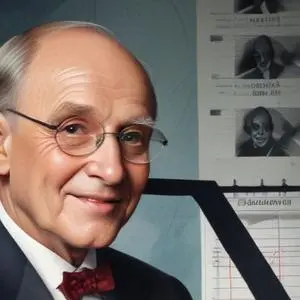
The Nobel Laureate: Unraveling the Brilliance of Edward C. Prescott
A Giant in Dynamic Macroeconomics
Edward C. Prescott, a luminary in the realm of economics, is renowned for his groundbreaking contributions to dynamic macroeconomics, particularly in the areas of time consistency of economic policy and the driving forces behind business cycles. In 2004, he was awarded the Nobel Memorial Prize in Economics, sharing the honor with Finn E. Kydland, for their pioneering work in this field.
Early Life and Education
Born on December 26, 1940, in Glens Falls, New York, Prescott was raised in an environment that fostered intellectual curiosity. He graduated with a bachelor's degree in mathematics from Swarthmore College in 1962, where he was a member of the Delta Upsilon fraternity. Furthering his academic pursuits, he earned a master's degree in operations research from Case Western Reserve University in 1963, followed by a Ph.D. in economics from Carnegie Mellon University in 1967.
A Career Marked by Excellence
Prescott's academic career spanned various prestigious institutions, including the University of Pennsylvania, Carnegie Mellon University, the University of Minnesota, and Arizona State University. He held visiting professorships at the University of Chicago and Northwestern University, and was a Ford Foundation Research Professor in 1978. His expertise was also sought after by the Federal Reserve Bank of Minneapolis, where he served as an economic advisor since 1981.
Awards and Honors
In addition to the Nobel Memorial Prize in Economics, Prescott received numerous accolades for his contributions to the field. He was ranked the 19th most widely cited economist in the world in 2013, according to the IDEAS-RePEc rankings. In 2014, he was appointed an Adjunct Distinguished Economic Professor at the Australian National University.
Philosophical Contributions and Beliefs
Prescott's work was characterized by a deep understanding of the complexities of economic systems. He believed in the importance of microfoundations in macroeconomics and was a proponent of the real business cycle (RBC) theory. His research focused on the development of models that could capture the underlying dynamics of economic phenomena, providing insights into the forces driving business cycles.
Influence on Modern Society
Prescott's contributions have had a profound impact on modern economic policy and practice. His work on time consistency has informed the development of monetary and fiscal policies, while his research on business cycles has improved our understanding of economic fluctuations. His influence extends beyond academia, shaping the decisions of policymakers and business leaders worldwide.
Personal Milestones and Key Life Events
Throughout his life, Prescott balanced his academic pursuits with personal milestones. He passed away on November 6, 2022, at the age of 81, leaving behind a legacy of intellectual rigor and excellence.
Comparative Analysis with Contemporaries
Prescott's work is often compared to that of his contemporaries, such as Robert Lucas and Thomas Sargent. While sharing similarities with their approaches, Prescott's focus on dynamic macroeconomics and his emphasis on microfoundations set him apart as a distinctive voice in the field.
Career Highlights and Major Works
- Nobel Memorial Prize in Economics (2004)
- "Rules Rather than Discretion: The Inconsistency of Optimal Plans" (1977)
- "Time to Build and Aggregate Fluctuations" (1982)
- "The Computational Experiment: An Econometric Tool" (1996)
Legacy
Edward C. Prescott's contributions to economics have left an indelible mark on the field. His work continues to inspire new generations of economists, policymakers, and scholars, ensuring that his legacy endures in the years to come.
FAQ
What is Edward Prescotts contribution to economics?
Edward Prescott is a Nobel Prize-winning economist who has made significant contributions to the field of macroeconomics, particularly in the area of general equilibrium theory and the theory of economic growth.
What is the Prescott-Summers debate?
The Prescott-Summers debate is a famous controversy in economics between Edward Prescott and Lawrence Summers over the causes of business cycles and the role of fiscal policy.
What awards has Edward Prescott won?
Edward Prescott was awarded the Nobel Memorial Prize in Economic Sciences in 2004 for his work on dynamic macroeconomic theory.
What is Edward Prescotts current affiliation?
Edward Prescott is currently a senior monetary policy advisor at the Federal Reserve Bank of Minneapolis and a professor at Arizona State University.
What is Edward Prescotts research focus?
Edward Prescotts research focuses on macroeconomic theory, particularly on the causes and consequences of business cycles, and on the design of optimal monetary and fiscal policies.