


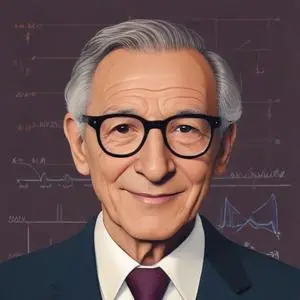
A Nobel Prize-winning economist who developed a growth model that showed technological progress is the primary driver of economic growth, and is known for his work on the theory of economic growth.
Robert Solow is renowned for his groundbreaking work on the theory of economic growth, which culminated in the development of the exogenous growth model that bears his name. This Nobel laureate's contributions have had a profound impact on our understanding of economic development, and his legacy continues to influence policymakers and economists worldwide.
Born on August 23, 1924, in Brooklyn, New York, Solow grew up in a Jewish family of modest means. Despite his parents not having the opportunity to attend college, they instilled in him a strong passion for learning, which propelled him to excel academically from an early age.
At 16, Solow received a scholarship to attend Harvard College, where he initially studied sociology and anthropology, as well as elementary economics. However, his academic pursuits were soon interrupted by World War II, during which he served in the U.S. Army, utilizing his fluency in German to intercept and interpret enemy messages.
After being discharged in 1945, Solow returned to Harvard, where he studied under the illustrious economist Wassily Leontief. As Leontief's research assistant, Solow produced the first set of capital coefficients for the input-output model, laying the foundation for his future work on economic growth.
In the following years, Solow became increasingly interested in statistics and probability models, which would become essential tools in his development of the Solow growth model. This model, which posits that economic growth is driven by technological progress and population growth, revolutionized the field of economics and earned Solow the Nobel Memorial Prize in Economic Sciences in 1987.
Throughout his illustrious career, Solow has had a profound impact on modern society, shaping the way policymakers approach economic development and growth. His work has inspired generations of economists, and his legacy continues to influence economic thought and policy.
Four of Solow's PhD students, including George Akerlof, Joseph Stiglitz, Peter Diamond, and William Nordhaus, have gone on to win Nobel Memorial Prizes in Economic Sciences in their own right. Moreover, one of his undergraduate students, H. Robert Horvitz, won the Nobel Prize in Medicine.
In 1945, Solow married his girlfriend, Barbara Lewis, whom he had been dating for six weeks. The couple remained together until her passing in 2014.
Throughout his life, Solow remained humble and dedicated to his craft, leaving behind a legacy that continues to inspire and influence economists, policymakers, and scholars around the world.
"I think the most important thing in the economy is getting the prices right. If you get the prices right, most of the other things will take care of themselves."
"The idea that economics is a science is an insult to science."
Solow's wisdom and wit have left an indelible mark on the world of economics, and his contributions will continue to shape the field for generations to come.
Born in 1915
A renowned economist and academic who made significant contributions to the field of economics, particularly in the areas of macroeconomics and international trade. He was awarded the Nobel Prize in Economics in 1970.
Born in 1912
A Nobel Prize-winning economist who championed free market capitalism and limited government intervention, known for his advocacy of laissez-faire economics and influential writings on monetary policy.
Born in 1883
A pioneering economist who revolutionized modern economic theory with his groundbreaking ideas on government intervention and fiscal policy, shaping global economic policies.
Born in 1920
Developed econometric models that accurately predicted economic trends and fluctuations, earning him the Nobel Prize in Economics in 1980.
Born in 1901
A Nobel Prize-winning economist and statistician who developed the concept of Gross National Product (GNP) and was a pioneer in the field of economic growth and development.
Born in 1918
Developed the life-cycle hypothesis, which explains how people save and spend money over their lifetimes, and made significant contributions to the field of macroeconomics.
83 Years Old
A Nobel Prize-winning economist and academic who has made significant contributions to the field of economics, particularly in the areas of information economics and globalization.
92 Years Old
A renowned economist and philosopher who has made significant contributions to welfare economics, social choice theory, and development economics, and is known for his work on poverty, famine, and human development.
