


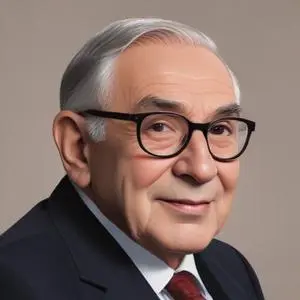
A Nobel Prize-winning economist who pioneered the theory of social choice and welfare economics, known for his work on the impossibility theorem, which challenges the idea of a perfectly fair voting system.
Kenneth Arrow, a renowned American economist, mathematician, and political theorist, is best known for his groundbreaking work in social choice theory, which earned him the Nobel Memorial Prize in Economic Sciences in 1972. His most significant contribution, Arrow's impossibility theorem, revolutionized the field of economics, providing a fundamental insight into the limitations of rational decision-making.
Born on August 23, 1921, in New York City, Arrow grew up in a family of Romanian Jews. His parents, Lilian Greenberg and Harry Arrow, were supportive of his education, which played a significant role in shaping his future. Arrow graduated from Townsend Harris High School and went on to earn a bachelor's degree in mathematics from the City College of New York in 1940.
During his graduate studies at Columbia University, Arrow was influenced by Harold Hotelling, which led him to switch fields from mathematics to economics. He obtained a master's degree in mathematics in June 1941 and later served as a weather officer in the United States Army Air Forces from 1942 to 1946.
Arrow's academic career was marked by his tenure at the Cowles Commission for Research in Economics at the University of Chicago, where he spent time as a research associate from 1946 to 1949. During this period, he also held the rank of Assistant Professor in Economics at the University of Chicago.
Arrow's work in social choice theory led to the development of Arrow's impossibility theorem, which states that it is impossible to design a voting system that satisfies a set of desirable properties. This theorem has far-reaching implications in economics, politics, and philosophy, and has been widely influential in shaping modern democratic theory.
In addition to his work in social choice theory, Arrow made significant contributions to general equilibrium analysis, endogenous growth theory, and the economics of information. His research has had a profound impact on the field of economics, and his students have gone on to win numerous Nobel Prizes.
Arrow's philosophical beliefs were shaped by his experiences during the Great Depression, which led him to embrace socialism in his youth. Although he later moved away from socialism, his views retained a left-leaning philosophy.
Arrow's work has had a lasting impact on the field of economics, and his influence extends beyond academia to policy-making and public discourse. His legacy serves as a testament to the power of human ingenuity and the importance of interdisciplinary approaches to understanding complex social and economic phenomena.
Kenneth Arrow's remarkable life and work serve as an inspiration to scholars and policymakers alike, reminding us of the importance of intellectual curiosity, rigor, and passion for creating a better world.
Born in 1752
Designed grand, neoclassical buildings in England, including the Royal Pavilion and Buckingham Palace, revolutionizing British architecture with his Regency style.
Born in 1915
A renowned economist and academic who made significant contributions to the field of economics, particularly in the areas of macroeconomics and international trade. He was awarded the Nobel Prize in Economics in 1970.
Born in 1912
A Nobel Prize-winning economist who championed free market capitalism and limited government intervention, known for his advocacy of laissez-faire economics and influential writings on monetary policy.
95 Years Old
A pioneer in applying economic theory to social issues, he's most known for his work on human capital, crime and punishment, and the economics of the family.
Born in 1924
A Nobel Prize-winning economist who developed a growth model that showed technological progress is the primary driver of economic growth, and is known for his work on the theory of economic growth.
92 Years Old
A renowned economist and philosopher who has made significant contributions to welfare economics, social choice theory, and development economics, and is known for his work on poverty, famine, and human development.
83 Years Old
A Nobel Prize-winning economist and academic who has made significant contributions to the field of economics, particularly in the areas of information economics and globalization.
Born in 1920
Developed econometric models that accurately predicted economic trends and fluctuations, earning him the Nobel Prize in Economics in 1980.
