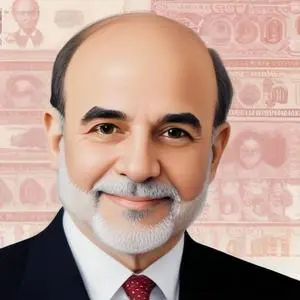
Ben Bernanke

Ben Bernanke

Ben Bernanke was born on December 13th, 1953

Full Name: Ben Shalom Bernanke
Nationality: American
Occupation: Economist
Position: Chairman of the Federal Reserve
Tenure: 2006-2014
Education: Ph.D. in Economics from MIT
Research Interests: Monetary Policy, Macroeconomics
Awards: Nobel Memorial Prize in Economic Sciences

The Chairman of the Federal Reserve during the 2008 financial crisis, credited with implementing unconventional monetary policies to stabilize the economy. Known for his calm and decisive leadership during tumultuous times.

Ben Bernanke: The Architect of Economic Stability

A Legacy of Crisis Management

Ben Bernanke, the 14th Chairman of the Federal Reserve, is renowned for his adept leadership during the 2008 global financial crisis, earning him the title of Time Magazine's 2009 Person of the Year. His tenure at the helm of the Federal Reserve, spanning from 2006 to 2014, was marked by unprecedented monetary policy decisions that stabilized the US economy and garnered international attention.

Early Life and Academic Pursuits

Born on December 13, 1953, in Augusta, Georgia, Bernanke was raised in Dillon, South Carolina. He earned his undergraduate degree in economics from Harvard University in 1975 and went on to pursue his Ph.D. in economics from the Massachusetts Institute of Technology (MIT) in 1979. Following his academic pursuits, Bernanke held various positions, including serving as a professor at Stanford University and Princeton University, where he chaired the Department of Economics from 1996 to 2002.

Rise to Prominence

Bernanke's transition to public service began in 2002, when he became a member of the Federal Reserve Board of Governors. During this period, he proposed the Bernanke Doctrine, which emphasized the importance of monetary policy in responding to economic downturns. In 2005, he became the Chairman of President George W. Bush's Council of Economic Advisers, solidifying his position as a leading economic mind.

Chairman of the Federal Reserve

On February 1, 2006, Bernanke took office as the Chairman of the Federal Reserve, succeeding Alan Greenspan. During his first term, he oversaw the Federal Reserve's response to the 2008 financial crisis, implementing unconventional monetary policies, such as quantitative easing, to stimulate economic growth. His leadership earned him a second term in 2010, and he continued to guide the economy through the recovery phase.

Philosophical Contributions and Beliefs

Bernanke's academic work focuses on the Great Depression, macroeconomic policy, and the role of central banks in responding to economic crises. His research, particularly in conjunction with Douglas Diamond and Philip H. Dybvig, has been instrumental in shaping modern understanding of financial crises. He is a proponent of the Great Moderation theory, which posits that traditional business cycles have declined in volatility due to structural changes in the international economy.

Awards and Honors

Influence on Modern Society

Bernanke's leadership during the financial crisis has had a lasting impact on global economic policy. His advocacy for centralized banking and unconventional monetary policies has influenced the strategies of central banks worldwide. His commitment to transparency and communication has raised the profile of central banks, making them more accountable to the public.

Personal Milestones and Key Life Events

Bernanke is married to Anna Friedmann, and they have two children, Joel and Alyssa. He is known for his calm demeanor and has been referred to as the "epitome of calm" by President Barack Obama.

Legacy and Historical Context

Bernanke's tenure at the Federal Reserve coincided with a period of unprecedented economic turmoil. His leadership, marked by a commitment to data-driven decision making and a willingness to challenge conventional wisdom, has left an indelible mark on the global economy. As a scholar, policymaker, and leader, Bernanke's legacy continues to shape the discipline of economics and inform the decisions of policymakers worldwide.

Post-Federal Reserve Career

After leaving the Federal Reserve in 2014, Bernanke was appointed a distinguished fellow at the Brookings Institution, where he continues to contribute to economic policy debates and research. He has also written two books, including The Courage to Act: A Memoir of a Crisis and Its Aftermath, which offers a firsthand account of his tenure as Chairman of the Federal Reserve.
Timeline
1953
Born in Augusta, Georgia
Ben Bernanke was born on December 13, 1953, in Augusta, Georgia.
1975
Harvard University
Bernanke earned his Ph.D. in economics from Harvard University.
1985
Federal Reserve
Bernanke began working at the Federal Reserve, eventually becoming the Chair of the Federal Reserve.
2006
Chairman of the Federal Reserve
Bernanke became the Chairman of the Federal Reserve, a position he held until 2014.
2013
Quantitative Easing
Bernanke implemented quantitative easing policies to stimulate the economy during the financial crisis.
Ben Bernanke

Ben Bernanke Quiz

What was Ben Bernanke's role during the 2008 financial crisis?

Score: 0/5
FAQ
What was Ben Bernankes role in the Federal Reserve?
Ben Bernanke served as the 14th Chairman of the Federal Reserve from 2006 to 2014, playing a crucial role in responding to the 2008 financial crisis and implementing quantitative easing policies.
What are Ben Bernankes thoughts on the Great Depression?
Ben Bernanke is a renowned expert on the Great Depression, and his research has focused on the causes and consequences of the crisis, including the role of monetary policy.
What awards has Ben Bernanke received?
Ben Bernanke was awarded the Nobel Memorial Prize in Economic Sciences in 2022 for his work on the Great Depression and his role in developing macroeconomic models.
What is Ben Bernankes educational background?
Ben Bernanke earned a Bachelors degree in economics from Harvard University and a Ph.D. in economics from the Massachusetts Institute of Technology (MIT).
What books has Ben Bernanke written?
Ben Bernanke has written several books, including Essays on the Great Depression and The Courage to Act: A Memoir of a Crisis and Its Aftermath, which chronicles his experiences as Federal Reserve Chairman.

Related People:

Alan Greenspan

Born in 1926

Former Chairman of the Federal Reserve, guiding the US economy through periods of growth and crisis, and known for his influence on monetary policy.

Paul Volcker

98 Years Old

A renowned economist who served as Chairman of the Federal Reserve, implementing monetary policies to combat inflation and stabilize the US economy. He's credited with ending the 1970s stagflation crisis.

Timothy Geithner

64 Years Old

The 75th United States Secretary of the Treasury, who played a crucial role in responding to the 2008 financial crisis and implementing policies to stabilize the economy. He's known for his leadership during a tumultuous period in American economic history.

Henry Paulson

80 Years Old

The 74th United States Secretary of the Treasury played a crucial role in shaping the country's economic policies, particularly during the 2008 financial crisis, and is known for his bold decisions to stabilize the economy. He's also a prominent banker and politician.

Lawrence Summers

71 Years Old

A renowned economist and academic who served as the Chief Economist of the World Bank and Secretary of the Treasury, known for his influential economic policies and theories.

Nouriel Roubini

68 Years Old

A prominent economist and consultant who predicted the 2008 financial crisis, known for his accurate forecasts and warnings about economic downturns.

Joseph Stiglitz

83 Years Old

A Nobel Prize-winning economist and academic who has made significant contributions to the field of economics, particularly in the areas of information economics and globalization.

Robert Reich

80 Years Old

The 22nd United States Secretary of Labor, a prominent economist and politician, is most known for championing workers' rights and advocating for economic policies that benefit the middle and working classes. They are a vocal critic of income inequality and a strong proponent of progressive economic reforms.