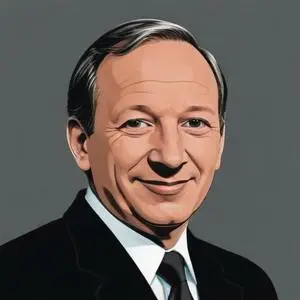
Lawrence Summers: The Economist with a Global Impact
A Leader in Global Economic Policy
Lawrence Summers is renowned for his influential role in shaping global economic policy, serving as the 71st United States Secretary of the Treasury and Director of the National Economic Council. As one of the most prominent economists of our time, Summers has left an indelible mark on the world of finance, academia, and politics.
Rise to Prominence
Born on November 30, 1954, Summers' fascination with economics began at an early age. He earned his Ph.D. in economics from Harvard University in 1982 and soon became a professor of economics at the same institution in 1983. His exceptional talent and expertise led to his appointment as the Chief Economist of the World Bank in 1991, followed by his role as Under Secretary for International Affairs of the United States Department of the Treasury under President
Bill Clinton's administration in 1993.
A Decade of Shaping Global Economy
Summers' impressive career spanned over a decade, during which he played a pivotal role in responding to global economic crises. He was instrumental in mitigating the 1994 economic crisis in Mexico, the 1997 Asian financial crisis, and the Russian financial crisis. His leadership in the Harvard Institute for International Development and his advocacy for the privatization of post-Soviet states' economies further solidified his reputation as a visionary economist.
A Turbulent Tenure at Harvard
In 2001, Summers became the 27th president of Harvard University, a position he held until 2006. Although his tenure was marked by controversy, including a high-profile conflict with
Cornel West and questions regarding his relationship with Andrei Shleifer, Summers' commitment to academic excellence and innovation remained unwavering.
Philosophical Contributions and Beliefs
Summers' philosophical approach to economics is rooted in his belief in the power of globalization and free markets. He has been an ardent advocate for deregulation, which he believes can stimulate economic growth and development. His views on women's underrepresentation in science and engineering have sparked debate, with some criticizing his comments as insensitive.
Influence on Modern Society
Summers' influence extends beyond the realm of economics to shape modern society. His commitment to education and innovation has inspired a new generation of leaders and thinkers. His contributions to the development of global economic policies have far-reaching consequences, impacting the lives of individuals and communities worldwide.
Personal Milestones and Key Life Events
- In 2005, Summers delivered a speech that sparked controversy, suggesting that women's underrepresentation in science and engineering might be due to innate differences.
- Summers married Elisa New, a Harvard professor, in 2005.
- In 2009, Summers became the Director of the National Economic Council, a position he held until 2010.
Controversies and Public Perception
Summers' career has been marked by controversy, including his views on women in science and engineering, his relationship with Andrei Shleifer, and his role in the deregulation of the U.S. financial system. Critics have accused him of being out of touch with the needs of marginalized communities and prioritizing corporate interests over social welfare.
Quotes and Memorable Sayings
- "In the history of the world, no one has ever washed a rented car."
- "The central irony of financial crisis is that while it is caused by too much confidence, too much borrowing, and too much spending... it is solved by more confidence, more borrowing, and more spending."
Legacy and Comparative Analysis
Lawrence Summers' legacy is complex and multifaceted. While some view him as a visionary economist who has shaped global economic policy, others criticize his views as outdated and insensitive. In comparison to his contemporaries, Summers' commitment to free markets and deregulation sets him apart, earning him both praise and criticism.
Predictions and Speculations
As Summers continues to shape the global economic landscape, one can only speculate about the impact of his future endeavors. Will his advocacy for artificial general intelligence revolutionize the world of finance, or will it exacerbate existing inequalities? Only time will tell.
FAQ
What is Lawrence Summerss most notable academic achievement?
Lawrence Summers is a renowned economist and academic, known for his work on macroeconomic policy and his tenure as president of Harvard University.
What was Lawrence Summerss role in the Obama administration?
Lawrence Summers served as Director of the National Economic Council under President Barack Obama, playing a key role in shaping the administrations economic policy.
What is Lawrence Summerss approach to economic policy?
Lawrence Summers is known for his pragmatic, centrist approach to economic policy, which emphasizes the importance of fiscal discipline and monetary policy.
What is Lawrence Summerss stance on globalization?
Lawrence Summers is a strong advocate for globalization, believing that it has the potential to drive economic growth and improve living standards.
How has Lawrence Summers influenced economic thought?
Lawrence Summers has made significant contributions to economic thought, particularly in the areas of macroeconomic policy and international economics.