


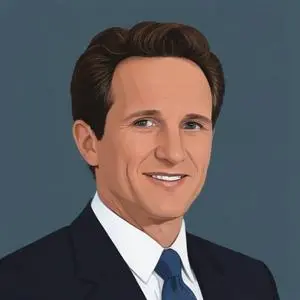
The 75th United States Secretary of the Treasury, who played a crucial role in responding to the 2008 financial crisis and implementing policies to stabilize the economy. He's known for his leadership during a tumultuous period in American economic history.
Timothy Geithner, the 75th Secretary of the United States Treasury, is widely regarded as the architect of the country's economic recovery from the 2008 financial crisis. As the right-hand man to President Barack Obama, Geithner played a pivotal role in shaping the nation's economic policy, navigating the treacherous waters of the Great Recession, and steadying the financial system.
Born on August 18, 1961, in Manhattan, New York, Geithner was raised in a family with a strong background in international development. His father, Peter Franz Geithner, worked for the United States Agency for International Development in Zambia and Zimbabwe, while his mother, Deborah Moore, was a Mayflower descendant. Geithner's paternal grandfather, Paul Herman Geithner, immigrated to the United States from Germany in 1908.
Geithner earned a Bachelor of Arts degree from Dartmouth College in 1983 and a Master of Arts in International Economics and East Asian Studies from Johns Hopkins University in 1985. He later studied at the Beijing Normal University, where he became proficient in Mandarin Chinese.
Geithner's career in public service began in 1988, when he joined the US Department of State as a assistant attaché in the Office of International Monetary Affairs. He quickly rose through the ranks, serving as a deputy assistant secretary for International Trade and Investment Policy from 1997 to 1998.
In 1999, Geithner became the under secretary of the Treasury for International Affairs, where he played a key role in responding to the Asian financial crisis and later served as the president of the Federal Reserve Bank of New York from 2003 to 2009.
In 2009, President Obama appointed Geithner as the Secretary of the Treasury, a role he held until 2013. During his tenure, Geithner oversaw the allocation of $350 billion under the Troubled Asset Relief Program (TARP), enacted to address the subprime mortgage crisis.
Geithner also played a crucial role in managing crises involving Bear Stearns, Lehman Brothers, and the American International Group (AIG). He worked closely with the Federal Reserve and other government agencies to stabilize the financial system, implementing policies to spur economic growth and restore confidence in the markets.
Geithner's leadership during the financial crisis earned him both praise and criticism. While some hailed him as a hero for preventing a complete collapse of the financial system, others criticized his close ties to Wall Street and the perceived lack of accountability for those responsible for the crisis.
Despite the controversy, Geithner's legacy as a crisis manager and economic leader is undeniable. He has been credited with helping to steer the US economy through its worst downturn since the Great Depression, and his efforts to reform the financial regulatory system have had a lasting impact on the global economy.
Since leaving the Treasury Department, Geithner has served as the president and managing director of Warburg Pincus, a private equity firm headquartered in New York City. He has also been involved in various philanthropic efforts, including serving on the board of the National Park Foundation.
In 2014, Geithner published his memoir, Quotes and Memorable Sayings
Awards and Honors
65 Years Old
The first African American to hold the office, he served two terms as President of the United States, earning a Nobel Peace Prize for his efforts to strengthen international diplomacy and cooperation. He's known for his charismatic leadership and commitment to progressive values.
72 Years Old
The Chairman of the Federal Reserve during the 2008 financial crisis, credited with implementing unconventional monetary policies to stabilize the economy. Known for his calm and decisive leadership during tumultuous times.
88 Years Old
Served as Treasury Secretary under President Clinton, playing a key role in shaping the country's economic policies and overseeing the deregulation of the financial industry. Known for his influence on the Gramm-Leach-Bliley Act, which repealed parts of the Glass-Steagall Act.
80 Years Old
The 74th United States Secretary of the Treasury played a crucial role in shaping the country's economic policies, particularly during the 2008 financial crisis, and is known for his bold decisions to stabilize the economy. He's also a prominent banker and politician.
Born in 1926
Former Chairman of the Federal Reserve, guiding the US economy through periods of growth and crisis, and known for his influence on monetary policy.
