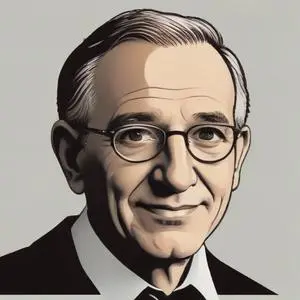
Amos Tversky: The Pioneer of Behavioral Economics
Unlocking the Secrets of Human Decision-Making
Amos Tversky, a renowned Israeli cognitive and mathematical psychologist, revolutionized the field of behavioral economics with his groundbreaking work on systematic human cognitive bias and risk management. Alongside his collaborator
Daniel Kahneman, Tversky co-authored the seminal work "Prospect Theory," which challenges traditional economic theories by demonstrating how humans make irrational economic choices.
Early Life and Education
Born on March 16, 1937, in Haifa, British Palestine (now Israel), Tversky was the son of a Polish-born veterinarian and a Lithuanian Jewish social worker. He demonstrated exceptional self-taught skills in mathematics and showed a keen interest in the subject from an early age. Tversky pursued his undergraduate degree from the Hebrew University of Jerusalem, graduating in 1961. He later earned his Ph.D. from the University of Michigan in 1965.
Foundational Contributions
Tversky's early work focused on the foundations of measurement, culminating in the co-authorship of a three-volume treatise, "Foundations of Measurement." He later shifted his attention to the psychology of prediction and probability judgment, collaborating with Kahneman to develop the "Heuristics and Biases" program. This innovative approach revealed how cognitive biases influence human decision-making, challenging traditional economic theories.
Prospect Theory and its Impact
The crowning jewel of Tversky's collaboration with Kahneman is Prospect Theory, a behavioral economic model that explains how humans make decisions under uncertainty. This groundbreaking theory challenged the notion of rational human behavior, instead highlighting how cognitive biases, emotions, and framing effects influence decision-making. Prospect Theory has far-reaching implications for fields such as finance, marketing, and public policy.
Influence and Legacy
Tversky's work has had a profound impact on modern society, with his concepts and theories influencing various domains, including:
- Behavioral economics and finance
- Marketing and advertising
- Public policy and decision-making
- Cognitive psychology and neuroscience
In recognition of his contributions, Tversky was ranked the 93rd most cited psychologist of the 20th century, alongside luminaries such as Edwin Boring,
John Dewey, and
Wilhelm Wundt.
Collaborations and Acknowledgments
Tversky collaborated with several prominent researchers, including Thomas Gilovich, Itamar Simonson, Paul Slovic, and Richard Thaler. His work with Daniel Kahneman earned Kahneman the 2002 Nobel Memorial Prize in Economic Sciences, with Kahneman acknowledging Tversky's integral role in their joint research.
Personal Milestones and Key Life Events
Tversky's personal life was marked by significant milestones, including his marriage to Barbara Tversky, a cognitive psychologist, and the birth of their three children. He was also an avid outdoorsman, enjoying activities such as hiking and camping.
Trivia and Fun Facts
* Tversky's mother, Jenia, was a social worker and member of the Knesset, representing the Mapai Workers Party.
* In high school, Tversky took classes from literary critic Baruch Kurzweil and befriended poet Dahlia Ravikovich.
Legacy and Inspirational Story
Amos Tversky's remarkable journey serves as an inspiration to scholars and researchers worldwide. His pioneering work in behavioral economics has opened doors to new avenues of research, challenging traditional theories and shaping our understanding of human decision-making. As a testament to his enduring legacy, Tversky's work continues to influence multidisciplinary fields, ensuring his impact will be felt for generations to come.
FAQ
What are the contributions of Amos Tversky to behavioral economics?
Amos Tverskys contributions to behavioral economics are immense, particularly in the development of prospect theory, which challenges the rational choice theory. His work with Daniel Kahneman led to a Nobel Prize in Economics in 2002.
What is the cognitive bias theory developed by Amos Tversky?
Amos Tversky and Daniel Kahneman developed the cognitive bias theory, which explains how people make irrational decisions based on mental shortcuts. This theory has far-reaching implications in fields such as finance, marketing, and politics.
What is the significance of the Tversky-Kahneman collaboration?
The collaboration between Amos Tversky and Daniel Kahneman led to groundbreaking research in behavioral economics, challenging traditional economic theories. Their work has influenced fields such as finance, psychology, and policy-making.
What is the impact of Amos Tverskys work on decision-making?
Amos Tverskys work has significantly influenced our understanding of decision-making, highlighting the role of cognitive biases and heuristics. This has led to the development of more effective decision-making strategies in various fields, including business and healthcare.
What is the legacy of Amos Tversky in the field of psychology?
Amos Tverskys legacy in psychology is profound, as he helped establish behavioral economics as a major field of study. His work has inspired numerous researchers and policymakers, leading to a better understanding of human decision-making and behavior.