


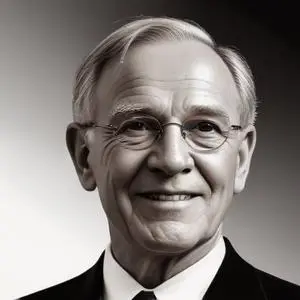
This Nobel Prize-winning economist is renowned for pioneering experimental economics, creating artificial markets to test economic theories and understand human decision-making. His work has far-reaching implications for policy-making and our understanding of human behavior.
Vernon L. Smith is a renowned American economist, known for his groundbreaking contributions to the field of experimental economics, which earned him the 2002 Nobel Memorial Prize in Economic Sciences, alongside Daniel Kahneman. His pioneering work in laboratory experiments has revolutionized the way economists analyze and understand market mechanisms, making him a household name in the world of economics.
Born on January 1, 1927, in Wichita, Kansas, Smith's early life was marked by hardship and resilience. After his mother's first husband, Grover Bougher, died in an accident, the life insurance money invested in a farm became the sole means of survival for the family during the Great Depression. This experience would later influence his interests and shape his perspectives on economics.
Smith attended Wichita North High School and Friends University, before receiving his bachelor's degree in electrical engineering. This unconventional background in engineering would later influence his approach to economics.
Smith's most notable contributions include his work in experimental economics, which involves designing and conducting laboratory experiments to test economic theories and analyze market behavior. His research has focused on understanding alternative market mechanisms, such as auctions and bargaining, and their implications for economic policy.
Some of his major works include:
Smith's work is deeply rooted in his philosophical beliefs about human decision-making and market behavior. He argues that economic models should be grounded in empirical evidence, rather than theoretical assumptions. His approach emphasizes the importance of experimentation and observation in understanding economic phenomena.
He has also been critical of mainstream economic theories, which he believes often overlook the complexities of human behavior and the importance of institutional factors in shaping market outcomes.
Smith's contributions to economics have been recognized with numerous awards and honors, including:
Smith's work has had a significant impact on modern society, shaping the way economists, policymakers, and business leaders think about market behavior and economic policy. His experimental approach has informed policy decisions in areas such as:
His influence extends beyond academia, with his ideas being applied in fields such as finance, law, and politics.
Vernon L. Smith's contributions to economics have cemented his place as one of the most influential economists of the 20th century. His pioneering work in experimental economics has opened up new avenues of research, inspired a generation of economists, and continues to shape our understanding of market behavior and economic policy.
As a testament to his legacy, the Vernon Smith Center for Experimental Economics Research was established in his honor at the Universidad Francisco Marroquín, a fitting tribute to a life dedicated to advancing the boundaries of economic knowledge.
Born in 1912
A Nobel Prize-winning economist who championed free market capitalism and limited government intervention, known for his advocacy of laissez-faire economics and influential writings on monetary policy.
95 Years Old
A pioneer in applying economic theory to social issues, he's most known for his work on human capital, crime and punishment, and the economics of the family.
87 Years Old
A Nobel Prize-winning economist and academic who developed the Efficient Market Hypothesis, which revolutionized our understanding of stock markets and investments.
85 Years Old
Developed the Black-Scholes model, a groundbreaking formula for pricing options and derivatives, revolutionizing financial markets and earning a Nobel Prize in Economics. This work has had a lasting impact on modern finance and investment strategies.
83 Years Old
A Nobel Prize-winning economist and academic who has made significant contributions to the field of economics, particularly in the areas of information economics and globalization.
73 Years Old
A Nobel Prize-winning economist and academic who has made significant contributions to the field of international trade and economic geography, and is also a prominent columnist and author.
92 Years Old
A renowned economist and philosopher who has made significant contributions to welfare economics, social choice theory, and development economics, and is known for his work on poverty, famine, and human development.
Born in 1752
Designed grand, neoclassical buildings in England, including the Royal Pavilion and Buckingham Palace, revolutionizing British architecture with his Regency style.
