


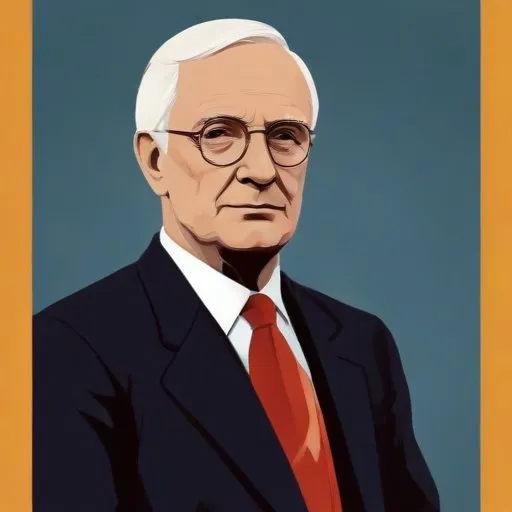
Historian and politician who wrote influential works on American history, including a Pulitzer Prize-winning biography of John Marshall, and served as a U.S. Senator from Indiana.
Known for his unwavering advocacy of American imperialism and his seminal biographies of iconic figures like Chief Justice John Marshall and President Abraham Lincoln, Albert J. Beveridge left an indelible mark on American politics and historiography. As a United States Senator from Indiana and a leading voice of the Progressive Era, Beveridge's influential writings and orations continue to shape our understanding of American history and its role in the world.
Born on October 6, 1862, in Highland County, Ohio, Beveridge grew up in a family that valued hard work and education. After his family moved to Indiana, he attended Sullivan Township High School, graduating in 1881. Despite facing financial difficulties, he worked tirelessly to secure an education, eventually becoming a law clerk in Indianapolis.
Beveridge's academic pursuits took him to Indiana Asbury University (now DePauw University), where he earned a Ph.B. degree in 1885. He was an active member of the Delta Kappa Epsilon fraternity and developed a passion for oratory, which would become a hallmark of his political career.
Beveridge's entry into politics was marked by his impassioned speeches in support of presidential candidate James G. Blaine in 1884. His oratorical prowess soon made him a sought-after figure in Republican circles, and he played a key role in the 1896 presidential campaign.
In 1899, Beveridge was appointed to the U.S. Senate, where he served until 1911. During his tenure, he became a vocal proponent of American imperialism, advocating for the annexation of the Philippines and the expansion of the U.S. Navy. His influential speeches and writings helped shape the national conversation on foreign policy and territorial expansion.
Beveridge's literary legacy is perhaps best exemplified by his acclaimed biographies of Chief Justice John Marshall and President Abraham Lincoln. These works showcased his masterful storytelling and deep understanding of American history, cementing his reputation as a premier historian of his era.
Beveridge married twice, first to Katherine Langsdale in 1887, and after her passing, to Catherine Eddy in 1907. He was a devoted member of the Freemasons, belonging to Oriental Lodge No. 500 in Indianapolis.
Albert J. Beveridge's contributions to American politics, historiography, and literature continue to resonate today. As a champion of progressive ideals, he helped shape the course of American history, leaving behind a rich legacy of written works and orations that inspire future generations.
Through his remarkable life and achievements, Albert J. Beveridge reminds us of the power of vision, determination, and intellectual curiosity. As we reflect on his legacy, we are inspired to pursue our own paths of discovery, driven by the same sense of purpose and passion that defined Beveridge's extraordinary career.
Born in 1858
A pioneering leader who championed progressive reforms, trust-busting, and conservation, earning a Nobel Peace Prize for mediating the Russo-Japanese War. He's also famous for his rugged outdoorsmanship and "big stick" diplomacy.
Born in 1856
The 28th President of the United States, a Nobel Peace Prize winner, and a historian who played a key role in shaping international relations and global governance after World War I. He's most known for his idealistic vision of a League of Nations and his efforts to promote peace and diplomacy.
Born in 1865
The 29th President of the United States, a journalist-turned-politician, led the country through a period of post-war prosperity and scandalous corruption. He's infamous for his administration's numerous scandals and his own extramarital affairs.
Born in 1872
The 30th President of the United States, a lawyer and politician, led the country through a period of economic prosperity and limited government intervention, earning the nickname "Silent Cal" for his frugal and humble nature. He's most known for his minimalist approach to governance and tax cuts.
Born in 1874
The 31st President of the United States was a humanitarian and politician who led the country through the Great Depression and is known for his humanitarian efforts and infrastructure development. He's also infamous for his inability to mitigate the economic crisis.
Born in 1882
Led the United States through the Great Depression and World War II, implementing a series of reforms known as the New Deal and helping to establish the country as a global superpower.
Born in 1884
The 33rd President of the United States, a strong leader who made tough decisions, including dropping atomic bombs on Japan and establishing the Marshall Plan to rebuild Europe after WWII.
Born in 1890
Led the Allied forces to victory in World War II and later served as President, maintaining peace and prosperity during the Cold War era. He's known for his strategic leadership and diplomatic skills.
