


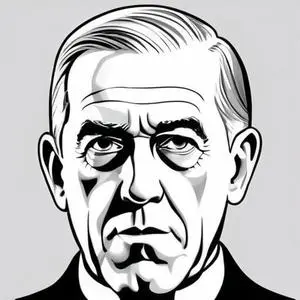
The 28th President of the United States, a Nobel Peace Prize winner, and a historian who played a key role in shaping international relations and global governance after World War I. He's most known for his idealistic vision of a League of Nations and his efforts to promote peace and diplomacy.
Woodrow Wilson, the 28th President of the United States, is best known for his unwavering commitment to international cooperation and domestic reform. As the leading architect of the League of Nations, Wilson played a pivotal role in shaping the global landscape after World War I, while his progressive stance on foreign policy came to be known as Wilsonianism.
Born on December 28, 1856, in Staunton, Virginia, Wilson grew up in the Southern United States during the American Civil War and Reconstruction era. He earned a Doctor of Philosophy in history and political science from Johns Hopkins University in Baltimore, which laid the foundation for his future academic and political pursuits.
Before entering politics, Wilson taught at several colleges, including Princeton University, where he emerged as a prominent spokesman for progressivism in higher education. His academic career was marked by a strong emphasis on liberal arts and a commitment to fostering critical thinking.
Wilson served as governor of New Jersey from 1911 to 1913, during which he broke with party bosses and won the passage of several progressive reforms. His success in New Jersey propelled him onto the national stage, and he mobilized progressives and Southerners to his cause at the 1912 Democratic National Convention.
Wilson defeated incumbent Republican William Howard Taft and third-party nominee Theodore Roosevelt to easily win the 1912 United States presidential election. During his first year as president, Wilson authorized the widespread imposition of segregation inside the federal bureaucracy, a decision that would later be subject to intense criticism. Despite this controversy, Wilson's first term was largely devoted to pursuing passage of his progressive New Freedom domestic agenda, which aimed to reduce tariffs, introduce a federal income tax, and strengthen antitrust laws.
Wilson's leadership during World War I marked a significant turning point in American history. He initially maintained a policy of neutrality, but eventually led the United States into the war in 1917, citing Germany's resumption of unrestricted submarine warfare and the sinking of the Lusitania as reasons for intervention.
Wilson's vision for a post-war world order centered on the creation of the League of Nations, an international organization dedicated to promoting collective security and preventing future wars. Although the League ultimately failed to prevent the outbreak of World War II, Wilson's idea of international cooperation and collective security remains a cornerstone of modern international relations.
Woodrow Wilson's legacy is complex and multifaceted. While his commitment to progressive reform and international cooperation remains an important part of his legacy, his record on civil rights and segregation is more problematic. Nevertheless, Wilson's influence on modern society is undeniable, and his progressive ideals continue to shape American politics and foreign policy to this day.
Woodrow Wilson's presidency occurred during a time of great upheaval, both domestically and internationally. His response to these challenges – from World War I to the rise of progressive reform – continues to shape our understanding of American history and inform our response to contemporary challenges.
Woodrow Wilson's presidency is often compared to that of his contemporaries, including Theodore Roosevelt and William Howard Taft. While each of these leaders brought their own unique style and approach to the presidency, Wilson's commitment to progressive reform and international cooperation sets him apart as a visionary leader.
Wilson's marriage to Ellen Axson Wilson was marked by a deep affection and partnership. Her death in 1914 was a devastating blow to Wilson, who later married Edith Galt Wilson in 1915.
Woodrow Wilson's legacy has been portrayed in numerous films, plays, and books, including the 1944 biographical film "Wilson," starring Alexander Knox.
Wilson's commitment to progressive reform extended beyond the realm of politics. He was a strong advocate for women's suffrage and labor rights, and his administration introduced several progressive reforms aimed at improving the lives of ordinary Americans.
Born in 1858
A pioneering leader who championed progressive reforms, trust-busting, and conservation, earning a Nobel Peace Prize for mediating the Russo-Japanese War. He's also famous for his rugged outdoorsmanship and "big stick" diplomacy.
Born in 1882
Led the United States through the Great Depression and World War II, implementing a series of reforms known as the New Deal and helping to establish the country as a global superpower.
Born in 1865
The 29th President of the United States, a journalist-turned-politician, led the country through a period of post-war prosperity and scandalous corruption. He's infamous for his administration's numerous scandals and his own extramarital affairs.
Born in 1872
The 30th President of the United States, a lawyer and politician, led the country through a period of economic prosperity and limited government intervention, earning the nickname "Silent Cal" for his frugal and humble nature. He's most known for his minimalist approach to governance and tax cuts.
Born in 1874
The 31st President of the United States was a humanitarian and politician who led the country through the Great Depression and is known for his humanitarian efforts and infrastructure development. He's also infamous for his inability to mitigate the economic crisis.
Born in 1857
The 27th President of the United States was a lawyer and jurist who served as the only person to hold the offices of President and Chief Justice of the United States. He's known for his significant contributions to the country's judicial system.
Born in 1884
A humanitarian and politician who championed human rights, women's empowerment, and social justice, leaving a lasting impact on American politics and international relations.
