


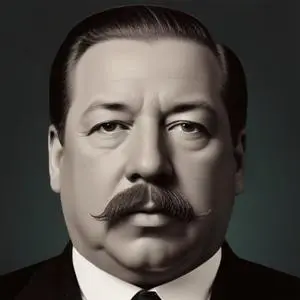
The 27th President of the United States was a lawyer and jurist who served as the only person to hold the offices of President and Chief Justice of the United States. He's known for his significant contributions to the country's judicial system.
William Howard Taft, the 27th President of the United States, is a stalwart figure in American history, distinguished by his unique dual legacy as both the President of the United States and the Chief Justice of the Supreme Court. This extraordinary feat, unmatched by any other American, underscores Taft's remarkable political acumen and his profound impact on the nation.
Born on September 15, 1857, in Cincinnati, Ohio, Taft was raised in a family steeped in public service. His father, Alphonso Taft, was a U.S. attorney general and secretary of war, setting the stage for his son's future political endeavors. Taft's academic pedigree was impressive, with degrees from Yale and the University of Cincinnati Law School, where he was a member of the Skull and Bones Society.
Taft's rapid ascent in politics began with his appointment as a judge in his early twenties. He served as solicitor general and later as a judge of the Sixth Circuit Court of Appeals, solidifying his reputation as a respected jurist. In 1901, President William McKinley appointed Taft as the civilian governor of the Philippines, a position that marked the beginning of his international diplomatic career.
In 1904, President Theodore Roosevelt appointed Taft as Secretary of War, further cementing his position as a trusted advisor and potential successor. Despite his own ambition to become Chief Justice, Taft deferred to Roosevelt's wishes and agreed to run for the presidency in 1908. With Roosevelt's endorsement, Taft handily won the Republican nomination and defeated William Jennings Bryan in the general election.
During his presidency, Taft focused on diplomacy in East Asia and Latin America, frequently intervening in regional conflicts. He also championed tariff reform, although the resulting bill was heavily influenced by special interests. Although his administration was marked by internal conflicts between conservative and progressive Republicans, Taft remained committed to his political agenda.
In 1921, President Warren G. Harding appointed Taft as Chief Justice of the Supreme Court, a position he held until a month before his death in 1930. As Chief Justice, Taft played a pivotal role in shaping American jurisprudence, overseeing landmark decisions on issues such as states' rights and civil liberties.
"Next to the right of liberty, the right of free inquiry is the most sacred and valuable of human privileges."
Born in 1858
A pioneering leader who championed progressive reforms, trust-busting, and conservation, earning a Nobel Peace Prize for mediating the Russo-Japanese War. He's also famous for his rugged outdoorsmanship and "big stick" diplomacy.
Born in 1856
The 28th President of the United States, a Nobel Peace Prize winner, and a historian who played a key role in shaping international relations and global governance after World War I. He's most known for his idealistic vision of a League of Nations and his efforts to promote peace and diplomacy.
Born in 1865
The 29th President of the United States, a journalist-turned-politician, led the country through a period of post-war prosperity and scandalous corruption. He's infamous for his administration's numerous scandals and his own extramarital affairs.
Born in 1872
The 30th President of the United States, a lawyer and politician, led the country through a period of economic prosperity and limited government intervention, earning the nickname "Silent Cal" for his frugal and humble nature. He's most known for his minimalist approach to governance and tax cuts.
Born in 1874
The 31st President of the United States was a humanitarian and politician who led the country through the Great Depression and is known for his humanitarian efforts and infrastructure development. He's also infamous for his inability to mitigate the economic crisis.
Born in 1882
Led the United States through the Great Depression and World War II, implementing a series of reforms known as the New Deal and helping to establish the country as a global superpower.
Born in 1831
The 20th President of the United States was a multifaceted leader who served as a general in the Civil War and later became a lawyer and politician, known for his strong advocacy for education and civil rights. He's also infamous for being assassinated just six months into his presidency.
Born in 1829
The 21st President of the United States, a strong advocate for civil service reform, is most known for signing the Pendleton Civil Service Act, which transformed the federal government's hiring practices. He's also remembered for his unexpected rise to presidency after the assassination of James A. Garfield.
