


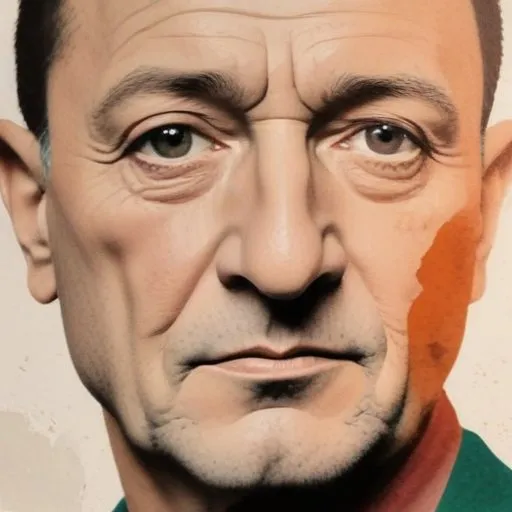
A pioneering artist who merged abstraction and realism, creating provocative assemblages from torn burlap, wood, and other unconventional materials, pushing the boundaries of modern art.
Italian artist Alberto Burri is renowned for his groundbreaking contributions to the European Informal Art movement, pioneering a unique style that blended painting, sculpture, and medicine. His profound influence on post-war art, particularly in the realm of matterism, has left an indelible mark on the art world.
Born on March 12, 1915, in Città di Castello, Umbria, Burri grew up in a family of modest means. His father, Pietro Burri, was a Tuscan wine merchant, and his mother, Carolina Torreggiani, was an elementary school teacher. Burri's early education took place in a government high school in Arezzo, where he boarded and studied Classics.
Following his high school education, Burri enrolled in the medical school in Perugia, graduating in 1940. His interest in tropical diseases led him to specialize in the field, and he went on to serve as a combat medic in Libya during World War II. This experience would later influence his artistic style, as he incorporated medical materials into his work.
Upon returning from the war, Burri's art career took off, and he began experimenting with unconventional materials, such as burlap, fabric, and wood. This innovative approach, dubbed "polymaterialism," rejected traditional artistic mediums and paved the way for a new generation of artists. Burri's works, with their textured, three-dimensional quality, blurred the lines between painting, sculpture, and installation art.
Burri's influence on modern art is undeniable. His work inspired artists like Antoni Tàpies, Robert Rauschenberg, and Lucio Fontana, and continues to inspire contemporary artists today. Despite being overlooked by some art historians, Burri's contributions to the European Informal Art movement are vast, and his legacy continues to grow.
Some of Burri's most notable works include his iconic "Sack" series, featuring burlap sacs filled with various materials, and his "Creto" series, showcasing abstract, earthy forms. His work has been exhibited in prestigious institutions worldwide, including the Museum of Modern Art (MoMA) in New York and the Tate Modern in London.
Burri's contributions to the art world have been recognized with numerous awards and honors, including the Grand Prize for Painting at the 1959 São Paulo Bienal and the Palma d'Oro Award at the 1962 Ljubljana Bienal.
Alberto Burri's innovative spirit, his refusal to conform to traditional artistic mediums, and his profound influence on modern art have cemented his place as one of the most important artists of the 20th century. His legacy continues to inspire, and his work remains a testament to the power of polymaterialism.
Born in 1899
A pioneer of Spatialism, a movement that seeks to break down the boundaries between art and space, he is renowned for his slashed and pierced canvases that redefine the concept of art.
93 Years Old
An Italian artist who created provocative and conceptual works, including a series of cans filled with his own feces, challenging traditional notions of art and its value.
Born in 1912
A renowned Italian painter and academic, known for his vibrant, abstract works that blended figurative and abstract elements, influencing the development of modern Italian art.
Born in 1890
A 20th-century master of still-life painting, capturing the essence of everyday objects in subtle, nuanced colors and compositions. His work continues to inspire artists and designers alike.
