


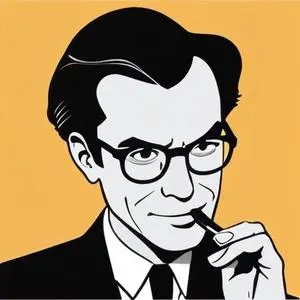
Author of dystopian classics like Brave New World, exploring the consequences of technological advancements on humanity. Known for prophetic warnings about government control and manipulation.
Aldous Huxley is renowned for his prophetic novel "Brave New World", a dystopian masterpiece that predicted a future where people are genetically engineered and conditioned to be happy and conform to society, but at the cost of individual freedom and creativity. With a writing career spanning nearly five decades, Huxley's works encompassed a wide range of genres, from novels and essays to poetry and screenplays, solidifying his position as one of the most influential intellectuals of the 20th century.
Born on July 26, 1894, in Godalming, Surrey, England, Huxley was the third son of Leonard Huxley, a writer and schoolmaster, and Julia Arnold, who founded Priors Field School. His family's intellectual and literary heritage paved the way for his future success. Huxley graduated from Balliol College, Oxford, with an undergraduate degree in English literature, laying the foundation for his writing career.
Huxley's bibliography boasts an impressive array of works, including novels, essays, poetry, and screenplays. Some of his notable works include:
Huxley's philosophical contributions were shaped by his interests in mysticism, universalism, and pacifism. He believed in the importance of individual freedom and creativity, and was critical of the dehumanizing effects of modern society. His philosophical works, such as The Perennial Philosophy, demonstrate his commitment to exploring the human condition and the nature of consciousness.
Huxley's life was marked by significant events that shaped his writing and philosophical trajectory:
Huxley's works have had a profound impact on modern society, influencing generations of writers, thinkers, and artists. His prophetic vision of a dystopian future has inspired countless works of science fiction, and his philosophical ideas continue to resonate with contemporary debates on individual freedom, creativity, and the role of technology in society.
Huxley's writings are replete with insightful quotes and memorable sayings, including:
Huxley's life and work are embedded in the historical context of the 20th century, a period marked by two world wars, the rise of totalitarian regimes, and the dawn of the digital age. His legacy continues to inspire new generations of writers, philosophers, and thinkers, ensuring that his ideas and works remain relevant and timely.
Huxley's work is often compared to that of his contemporaries, including George Orwell, who also explored dystopian themes in his novel "1984". While both authors warned of the dangers of totalitarianism, Huxley's focus on the dehumanizing effects of modern society and the importance of individual freedom and creativity sets him apart from Orwell's more overtly political critique.
A visual timeline of Huxley's life and works would include:
Aldous Huxley's life and works are a testament to his unwavering commitment to exploring the human condition, individual freedom, and the role of technology in society. His prophetic vision of a dystopian future and his philosophical contributions continue to inspire and challenge new generations of thinkers, writers, and artists.
Born in 1903
A renowned writer of dystopian classics, such as "1984" and "Animal Farm", who warned of totalitarianism's dangers through allegorical fiction.
Born in 1898
Renowned author of fantasy series, including The Chronicles of Narnia, and prominent Christian apologist, exploring the intersection of faith and reason.
Born in 1892
Creator of Middle-earth, a richly detailed fantasy world, and author of The Hobbit and The Lord of the Rings trilogy, which have become cultural touchstones.
Born in 1903
A renowned English writer, known for his witty satires and novels of manners, particularly "Brideshead Revisited", which explores the British aristocracy's decline.
74 Years Old
A Canadian actor who appeared in over 150 films and TV shows, often playing Native American and First Nations characters, and was a pioneer for Indigenous representation in media.
Born in 1879
This celebrated author crafted novels and plays that probed the human condition, exploring themes of social class, morality, and personal relationships, with a distinctive wit and insight. Their works continue to captivate audiences with their nuanced portrayals of English society during the early 20th century.
Born in 1882
A pioneering author of modernist literature, known for experimental novels and essays that explored the human experience, blurring the lines between reality and fiction.
Born in 1872
A renowned thinker who made significant contributions to mathematics, philosophy, and social commentary, known for his influential writings on logic, ethics, and politics. He's a prominent figure in shaping modern intellectual thought.
