


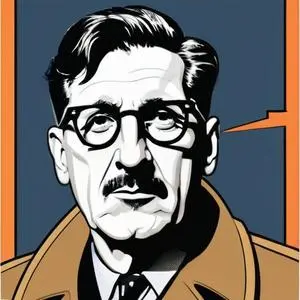
A renowned writer of dystopian classics, such as "1984" and "Animal Farm", who warned of totalitarianism's dangers through allegorical fiction.
George Orwell, the iconic English novelist, poet, essayist, and critic, is renowned for his thought-provoking works that continue to resonate with readers worldwide. His masterpieces, Animal Farm and Nineteen Eighty-Four, are legendary dystopian novels that pierce the veil of totalitarianism, warning us about the dangers of government control and manipulation.
Born Eric Arthur Blair on June 25, 1903, in Motihari, India, Orwell was raised and educated in England from the age of one. His early years were marked by a sense of social consciousness, which would later become a hallmark of his writing. After attending Eton College, Orwell served as an Imperial policeman in Burma (now Myanmar) from 1922 to 1927. This experience deeply influenced his perception of colonialism and the exploitation of the working class.
Orwell's writing career began to take shape in the late 1920s, with his first articles and short stories published in various magazines. His early novels, such as Burmese Days (1934) and A Clergyman's Daughter (1935), explored themes of colonialism, poverty, and the human condition. However, it was his experiences during the Spanish Civil War that cemented his reputation as a prominent writer and thinker.
Orwell's participation in the Spanish Civil War (1936-1939) as a soldier for the Republican faction inspired his classic work, Homage to Catalonia (1938). This memoir not only chronicled his experience but also provided a scathing critique of Stalinism and the dangers of totalitarianism. The war left Orwell wounded and ill, but it also galvanized his writing, leading to some of his most influential works.
Orwell's literary output is characterized by lucid prose, social criticism, and a commitment to democratic socialism. His most famous works include:
Orwell's work has had a profound influence on modern society, politics, and popular culture. His concepts, such as "Big Brother," "doublethink," and "newspeak," have become part of our cultural lexicon. His warnings about government surveillance, censorship, and manipulation continue to resonate in today's world.
Freedom is the freedom to say that two plus two equals four. If that is granted, all else follows.
-- George Orwell
Orwell's life was marked by illness and hardship, particularly in his later years. He died on January 21, 1950, at the age of 46, leaving behind a body of work that continues to inspire, provoke, and warn us about the dangers of totalitarianism. Despite the challenges he faced, Orwell's vision, courage, and dedication to the truth have cemented his place as one of the most important writers of the 20th century.
Born in 1903
A renowned English writer, known for his witty satires and novels of manners, particularly "Brideshead Revisited", which explores the British aristocracy's decline.
Born in 1894
Author of dystopian classics like Brave New World, exploring the consequences of technological advancements on humanity. Known for prophetic warnings about government control and manipulation.
Born in 1888
Pioneering author of hard-boiled detective fiction, crafting gritty, atmospheric tales of crime and corruption that continue to influence literature and film. His works are iconic for their dark, witty, and poetic style.
74 Years Old
A Canadian actor who appeared in over 150 films and TV shows, often playing Native American and First Nations characters, and was a pioneer for Indigenous representation in media.
Born in 1857
A Polish-born British novelist who wrote thought-provoking and psychologically complex stories that explored the human condition, often set against the backdrop of colonialism and the sea.
Born in 1885
A pioneering writer of the early 20th century, known for exploring themes of human nature, relationships, and the clash between individual desire and societal expectations through novels like "Sons and Lovers" and "Lady Chatterley's Lover".
Born in 1882
A pioneering author of modernist literature, known for experimental novels and essays that explored the human experience, blurring the lines between reality and fiction.
Born in 1879
This celebrated author crafted novels and plays that probed the human condition, exploring themes of social class, morality, and personal relationships, with a distinctive wit and insight. Their works continue to captivate audiences with their nuanced portrayals of English society during the early 20th century.
